How to Do English Dictation the Right Way, Step by Step

On this page
Listening dictation is advice every English learner has heard. What few people spell out is how to do it right, so a lot of people open up an audio clip, manage to transcribe a few sentences, see they got almost everything wrong, and conclude this method just isn't for them.
Usually it's not that it isn't for you. Usually you're doing one of four steps wrong, and the step that gets skipped most often is exactly the one step that makes you improve.
This article walks through the right process, along with specific mistakes Vietnamese ears tend to trip over. If you're looking for a tool to transcribe with, the article comparing 8 dictation websites and apps answers that question.
- Four steps, in the right order
- Choosing a passage at the right level
- Four groups of mistakes Vietnamese ears tend to trip over
- How long per session, how long until you improve
- Frequently asked questions
Four steps, in the right order
The order matters more than people think. Reversing the steps is the fastest way to turn a study session into typing practice.
Step 1: Listen through once, without writing anything
The point of this pass isn't to understand, it's to get oriented: what's the topic, how many speakers, what does the voice sound like, fast or slow. It's fine if you only catch a little.
Skip this step and you have to guess the content and catch every word at the same time, and your brain will pour all its effort into guessing.
Step 2: Transcribe sentence by sentence
Listen to one sentence, pause, write it down. Rewind that sentence if you need to. The one rule to remember: after about five tries, if you still can't get it, leave it blank and move on.
Listening a fifteenth time almost never helps. If the word isn't already in your head, listening more won't conjure it up, and you're just burning through your own patience. A blank is information, not failure.
Step 3: Check against the transcript
This is the decisive step, and also the one that gets skipped most. Compare what you wrote against the original, word by word.
Don't just count how many you got wrong. Look at what kind of mistake it is, because listening errors almost always fall into a few fixed categories, and knowing which category you fall into tells you exactly what to pay attention to next time.
Step 4: Listen again to exactly the sentences you got wrong
Open up the sentences you missed and listen again, now that you know the answer. That feeling of "oh, it was right there and I just didn't catch it" is the moment your ear actually learns something.
Skip steps 3 and 4 and the session you just did was nothing but a typing drill. Seriously: if you only have ten minutes some day, transcribe less rather than dropping the last two steps.
Choosing a passage at the right level
A passage at the right level is one where you grasp the general idea on the first listen but definitely miss some details. If you transcribe it and get almost everything wrong, the passage is too hard, and you'll burn out within three days. If you transcribe it almost entirely correctly, the passage isn't teaching you anything new.
A simple way to check yourself: after checking against the transcript, if the number of blanks you left is more than about a quarter of the words, drop down a level.
Length works the same way. One or two minutes of audio is plenty for one session. It sounds short, but transcribing it sentence by sentence will eat up a full twenty minutes, and that's normal.
If you're not sure where you stand, take the listening level test once and choose based on the result — it'll save you a few weeks of fumbling around.
Four groups of mistakes Vietnamese ears tend to trip over
After a few sessions, you'll notice your mistakes repeat. Here are the four most common groups, with concrete examples.
| Error group | You hear it as | It's actually |
|---|---|---|
| Swallowed final sounds | ask | asked |
| Linking sounds | anowuranahaf | an hour and a half |
| Contracted forms | he would | he'd |
| Reduced function words | (hear nothing at all) | of, at, to |
Final sounds and word endings
Vietnamese doesn't have aspirated final consonants the way English does, so our ears default to skipping over them. The result is weeks heard as week, walked as walk. What's worth noting is that losing the ending also loses the tense and the plural — that is, you lose meaning, not just sound.
Linking sounds
Native speakers don't pronounce words separately. an hour and a half comes out of the mouth as one solid block. When transcribing, you'll find yourself writing down a meaningless string and then just leaving it blank. This is the error group that improves most clearly through dictation practice, because you're forced to break that block apart into individual words.
Contracted forms
he'd, they've, would've, should've go by very fast. A small tip: when you notice that what you transcribed is missing an auxiliary verb but still seems grammatically fine, there's a good chance a contracted form slipped past you right there.
Function words
Short words that carry no stress get reduced almost to nothing. They barely affect meaning, so a lot of people ignore them. But they're exactly what lets you hear a whole sentence instead of catching a few keywords and guessing the rest.
How long per session, how long until you improve
Twenty minutes a day, done consistently, beats two hours crammed into the weekend. Because you have to transcribe sentence by sentence, this kind of practice is fairly taxing on the brain, and doing it short but regular is the only way to keep the habit alive.
As for progress, how you feel is a poor indicator: on a day you slept well you feel like you've suddenly gotten good, on a tired day you feel like you've gotten worse, while your actual level hasn't changed at all. A few more reliable signs:
- At the same difficulty level, the number of blanks you leave keeps shrinking.
- You need fewer rewinds per sentence.
- An error group that used to repeat, like the -ed ending, becomes rarer.
- You start hearing function words that simply didn't exist for you before.
Progress in listening skill comes in steps, not a straight line. You might see nothing for several weeks in a row, then suddenly a passage that used to be hard becomes manageable.
Frequently asked questions
Should I transcribe by hand or type it?
Typing is faster, so you get through more in the same amount of time, and a tool can grade it instantly. Writing by hand is slower, but some people find it sticks better in memory. There's no single right answer — pick whichever one you'll actually keep doing.
Should I turn on subtitles while transcribing?
No, not while you're transcribing. Subtitles turn a listening exercise into a reading exercise. Only open the transcript at the checking step.
Does dictation practice help with IELTS or TOEIC?
Yes, indirectly. Those exams test your ability to catch detail while listening, and dictation trains exactly that: numbers, proper names, verb endings, reduced function words. Those are also the places where points get lost most often.
If I don't understand anything at all, should I still transcribe?
No. If you can't grasp the general idea on the first listen, the passage is too hard, and transcribing will just be transcribing meaningless sound. Drop down to an easier passage.
How long before I should raise the difficulty?
When you transcribe a passage at your current level and only a scattered few spots are left wrong, and those remaining spots no longer belong to the same error group.
Getting started
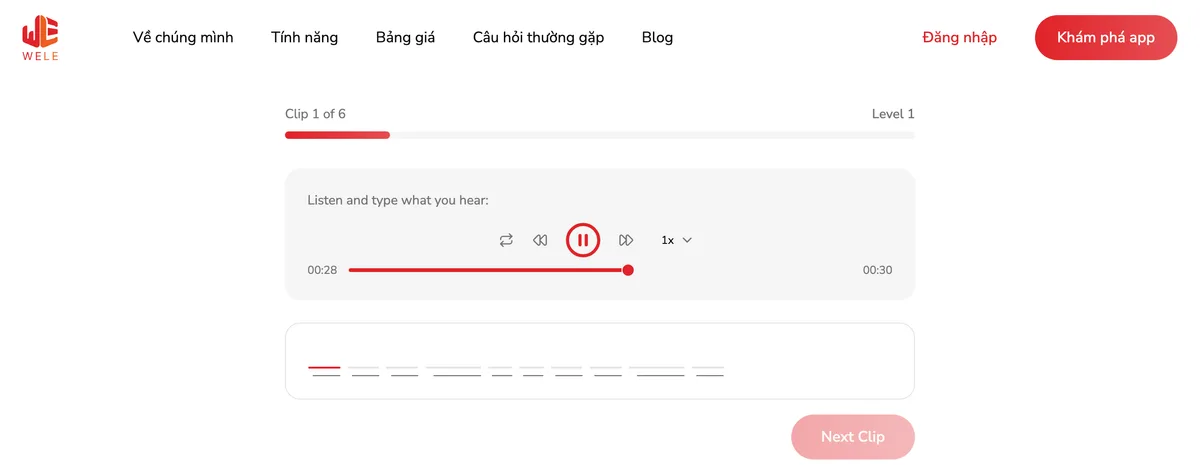
Pick a short passage at the right level, set a timer for twenty minutes, and follow the four steps above exactly, especially the last two. If you want a ready-made accurate transcript, a player that cuts audio by sentence, and a grader that points out each missed word, you can start transcribing on WELE for free.
Read more: comparing 8 dictation websites and apps if you're choosing a tool, and a 20-minute daily listening practice framework if you want to turn this into a habit.
