Kitchen English: How to Keep Up With Line Calls, Plus a Self-Study Roadmap

On this page
- Why kitchen English is hard in its own particular way
- Kitchen hierarchy: who calls, who answers
- Cooking verbs: hear one word, know what to do
- Shift-call shouts
- French-derived words: spelled one way, said another
- Tools, equipment, and food safety
- How to learn kitchen vocabulary so it actually sticks
- Common mistakes
- Learning to the kitchen's rhythm
- Frequently asked questions
You have no trouble reading an English recipe. The words sit still on paper, you have time to look things up, and if you forget, you reread the line above. But on a shift in an international hotel kitchen, the person at the pass barks out a three-second line, the whole line answers "Heard, chef," and you're still not sure what you just heard.
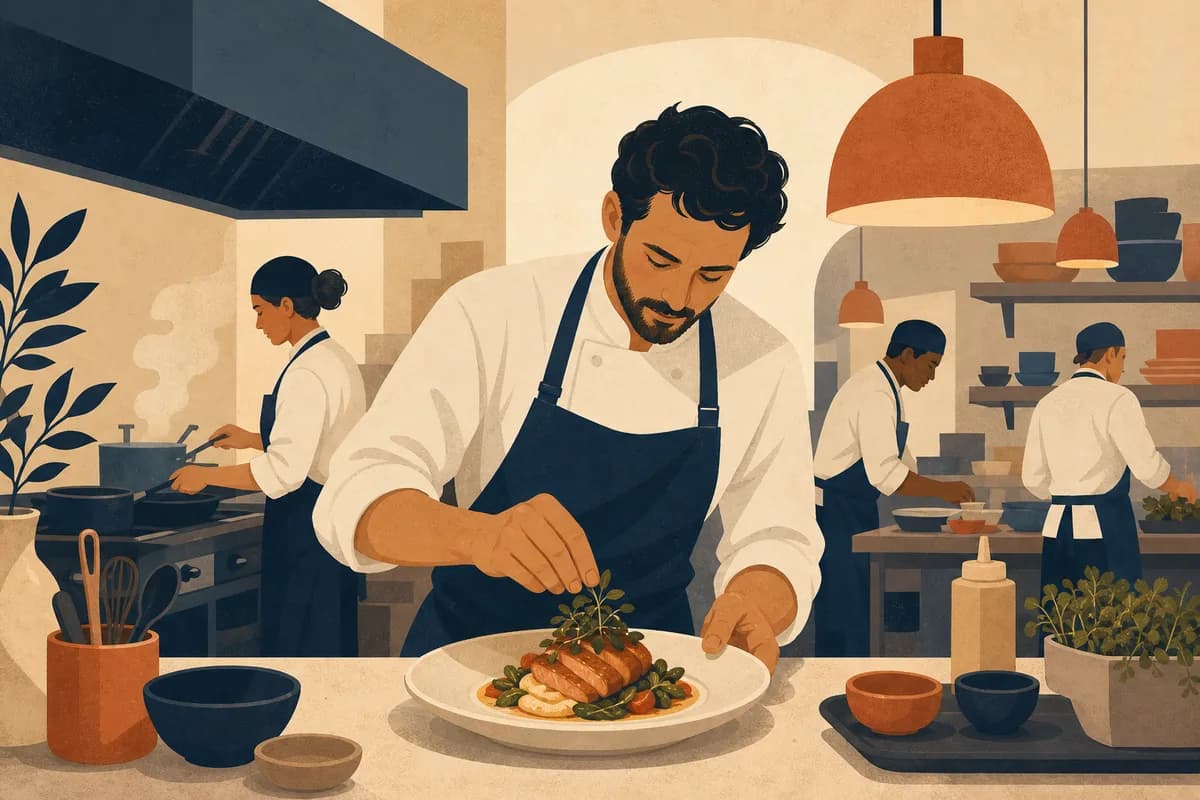
English in a kitchen differs from every other field in one way: it's shouted, not written. It's cut down to the bone, spoken over the extractor fan and the clang of pans, and nobody says it twice. "Fire table six" gets called once. "Behind" gets called once too, and if you don't catch it in time, whoever's carrying hot oil behind you walks straight into you.
This article goes straight into that part. The centerpiece is the set of shift-call shouts, the thing no kitchen vocabulary list ever bothers to list. Around it sit kitchen hierarchy, cooking verbs, tools and equipment, food safety, and the group of French-derived words spelled one way and pronounced a completely different way. There's no cooking instruction here — you know more about that than this article does.
- Why kitchen English is hard in its own particular way
- Kitchen hierarchy: who calls, who answers
- Cooking verbs: hear one word, know what to do
- Shift-call shouts
- French-derived words: spelled one way, said another
- Tools, equipment, and food safety
- How to learn kitchen vocabulary so it actually sticks
- Common mistakes
- Learning to the kitchen's rhythm
- Frequently asked questions
Why kitchen English is hard in its own particular way
Kitchen vocabulary itself isn't hard. Most of it is everyday words: pan, knife, oven, salt. The difficulty sits in three layers stacked on top of each other, and none of them comes apart just by memorizing a list.
The first layer is the environment. Kitchens are loud, hot, and everyone is talking while doing something else at the same time. Calls come out with no subject, no article, just two to four words. "Two steaks all day" is a perfectly valid sentence in a kitchen but breaks every grammar rule you've ever learned.
The second layer is internal code. "86" means we're out of that dish. "All day" means the total count owed as of right now. "In the weeds" means overwhelmed with work. Look these up in a regular dictionary and you won't find their kitchen meaning, because this is trade slang, used daily in almost every English-speaking kitchen.
The third layer is French. The Western kitchen system is built on the French brigade de cuisine model, so job titles and techniques all carry French names — but pronounced the way the British, Americans, and Australians say them. Looking at "hors d'oeuvre" and guessing the sound "or-DERV" is almost impossible.
If your job is on the front side of the house — greeting guests, taking reservations, handling complaints — that vocabulary set is in the article restaurant and hotel English. This article is on the inside, from the pass in.
Kitchen hierarchy: who calls, who answers
Before learning the words, you need to know who's talking to you. Western kitchens run on a very clear hierarchy, and that hierarchy decides which sentence is an order you must execute right now and which is just a question.
One thing that trips up newcomers: "chef" is both a job title and a form of address. Anyone ranked above you in the kitchen is called "chef," and the standard reply is "Yes, chef" or "Heard, chef." This isn't optional politeness — silence is read as you not having heard, and they'll call it out again, louder.
The table below is ranked top to bottom by hierarchy. In a small kitchen one person might carry three roles, but the titles are still used exactly as they are.
| Word / phrase | Pronunciation | Meaning | Example sentence |
|---|---|---|---|
| executive chef | /ɪɡˈzekjətɪv ʃef/ | executive chef, manages multiple kitchens | "The executive chef signs off on every new menu." |
| head chef | /ˌhed ˈʃef/ | head of a kitchen, the common term in the UK and Australia | "The head chef wants the fridge lists done before service." |
| chef de cuisine | /ˌʃef də kwɪˈziːn/ | head chef, the French-system term | "Ask the chef de cuisine before you change the garnish." |
| sous chef | /ˌsuː ˈʃef/ | deputy chef, runs the kitchen when the head chef is out | "The sous chef runs the pass tonight." |
| chef de partie | /ˌʃef də pɑːrˈtiː/ | station head, in charge of a group of dishes | "You're chef de partie on sauce this week." |
| demi chef | /ˈdemi ʃef/ | deputy station head | "He's demi chef on larder, second to Anna." |
| commis | /ˈkɒmi/ | apprentice cook, the final s is silent | "Send a commis to the dry store for flour." |
| line cook | /ˈlaɪn kʊk/ | cook working the line during service | "We're two line cooks short tonight." |
| expeditor | /ˈekspədaɪtər/ | the person coordinating between kitchen and floor, called "expo" for short | "The expo calls the tickets, you just cook them." |
| saucier | /ˈsoʊsieɪ/ | cook in charge of sauces and hot dishes | "The saucier starts the stock before anyone clocks in." |
| garde manger | /ˌɡɑːrd mɑːnˈʒeɪ/ | the cold section: cold apps, salads | "Garde manger, four Caesars on the fly." |
| pastry chef | /ˈpeɪstri ʃef/ | head of pastry and desserts | "The pastry chef needs the walk-in cleared by ten." |
| kitchen porter | /ˈkɪtʃɪn ˈpɔːrtər/ | kitchen cleaning staff, abbreviated KP | "The kitchen porter hasn't turned up, we're washing our own pans." |
| station | /ˈsteɪʃn/ | the post you're assigned to for the shift | "What station are you on tonight, grill or fry?" |
| the pass | /ðə ˈpæs/ | the counter where dishes move from kitchen to floor | "Everything goes through the pass, nothing leaves the side door." |
Cooking verbs: hear one word, know what to do
Cooking verbs almost always show up as commands, one or two syllables, no subject. "Sear it." "Reduce it." "Rest it." Precisely because they're short, they slip past your ear easily, especially right after a string of information about which table and how many covers.
A few pairs in this table are easy to mix up when heard fast. Poach and blanch are both about hot water, braise and simmer are both slow cooking, but the actual action is completely different. The example column shows you what each verb typically travels with, and those companion words are exactly the clue you use to guess when you miss the first sound.
| Word / phrase | Pronunciation | Meaning | Example sentence |
|---|---|---|---|
| sear | /sɪr/ | cook hard and fast to brown the outside | "Sear the duck skin-side down until it's golden." |
| braise | /breɪz/ | cook slowly in a small amount of liquid, covered | "We braise the short ribs overnight at low heat." |
| poach | /poʊtʃ/ | cook gently in barely simmering water | "Poach the eggs in vinegar water, three minutes." |
| blanch | /blæntʃ/ | plunge briefly then straight into ice water | "Blanch the beans and shock them straight away." |
| sauté | /soʊˈteɪ/ | cook fast over high heat with a little oil | "Sauté the mushrooms hard, don't let them steam." |
| simmer | /ˈsɪmər/ | keep at a gentle heat, never a full boil | "Keep the stock at a simmer, never a rolling boil." |
| julienne | /ˌdʒuːliˈen/ | cut into thin matchstick strips | "Julienne the carrots, matchstick size, not chunks." |
| deglaze | /diːˈɡleɪz/ | add wine or stock to lift the browned bits off the bottom of the pan | "Deglaze the pan with white wine and scrape the bottom." |
| reduce | /rɪˈduːs/ | boil down until it thickens | "Reduce it by half, it's too thin to coat." |
| skim | /skɪm/ | remove foam and fat from the surface | "Skim the stock every twenty minutes or it goes cloudy." |
| render | /ˈrendər/ | melt fat out of meat over low heat | "Render the fat slowly, don't rush the pan." |
| baste | /beɪst/ | spoon hot fat over meat while it cooks | "Baste it with the butter and thyme for the last minute." |
| rest | /rest/ | let meat sit after cooking before slicing | "Let the steak rest three minutes before you slice it." |
| fold | /foʊld/ | mix gently in a folding motion so it doesn't collapse | "Fold the egg whites in, don't stir them." |
| temper | /ˈtempər/ | combine gradually to avoid a heat shock | "Temper the yolks with a little hot cream first." |
| proof | /pruːf/ | let dough rise | "The dough proofs for an hour in the warm cupboard." |
| season | /ˈsiːzn/ | add salt and pepper to taste | "Season it now and taste it again before it goes out." |
| plate | /pleɪt/ | arrange the dish on the plate | "Plate it now, the expo's calling table nine." |
Shift-call shouts
This is the most important table in the article, and also the part every "kitchen vocabulary" list skips. These aren't words for writing in a report — they're signals you react to in one second.
The rhythm of a shift goes roughly like this. A ticket comes in, the expeditor calls out "Ordering" and the stations start prepping. When it's time to actually cook, that person calls "Fire." While waiting, the count is tracked with "all day": table four ordered two ribeyes, table nine ordered four, so that's "six ribeyes all day." When a dish is about to leave the kitchen, they call "Pick up." When plates are sitting there with nobody carrying them, someone calls "Hands."
Woven through all this is the safety-signal group, and this is the group you have to react to before you've even had time to understand the meaning. "Behind" means someone is right behind you — stand still, don't turn around, don't step back. "Corner" means someone's about to turn a blind corner. "Sharp" means a knife is coming through. "Hot" means something hot is passing. In a busy kitchen these words get called constantly, and nobody waits for you to translate in your head.
"86" in particular is almost a code word. Hearing "86 the salmon" means the salmon is out, stop taking orders for it, tell the floor right now. There are several theories about where this number comes from and none of them is confirmed, but the meaning is used identically in every English-speaking kitchen.

| Call | Pronunciation | Meaning | Heard during a shift |
|---|---|---|---|
| Behind | /bɪˈhaɪnd/ | someone is right behind you, stand still, don't turn around | "Behind, hot pan." |
| Corner | /ˈkɔːrnər/ | someone's about to turn a blind corner, slow down | "Corner, coming through." |
| Sharp | /ʃɑːrp/ | a knife is being carried through | "Sharp, behind you." |
| Hot | /hɑːt/ | something hot is passing, get out of the way | "Hot, hot, coming out of the oven." |
| Heard | /hɜːrd/ | I heard you clearly, confirming an order received | "Fire table six." "Heard, chef." |
| Yes, chef | /jes ʃef/ | the standard reply to anyone ranked above you | "Two lamb, medium rare." "Yes, chef." |
| Ordering | /ˈɔːrdərɪŋ/ | a new ticket has come in, get ingredients ready | "Ordering, two soups, one salad." |
| Fire | /ˈfaɪər/ | start cooking that dish right now | "Fire two steaks, one salmon." |
| Working | /ˈwɜːrkɪŋ/ | I'm on that dish, confirming it's underway | "Working two lamb, five minutes." |
| All day | /ˌɔːl ˈdeɪ/ | the running total of covers owed as of now | "That's six ribeyes all day." |
| Pick up | /ˈpɪk ʌp/ | get ready to finish, the dish is about to go out | "Pick up table twelve, mains in four." |
| Hands | /hændz/ | need someone to carry this dish out now | "Hands, please, table four is dying in the window." |
| In the window | /ɪn ðə ˈwɪndoʊ/ | the dish is sitting out waiting under the heat lamp, dying the longer it sits | "Two plates in the window, someone take them." |
| 86 | /ˌeɪti ˈsɪks/ | out of stock, stop selling, tell the floor now | "86 the salmon, we're out until tomorrow." |
| On the fly | /ˌɒn ðə ˈflaɪ/ | rush it, jump it ahead of the queue | "One risotto on the fly, they've been waiting." |
| In the weeds | /ɪn ðə ˈwiːdz/ | overwhelmed, can't keep up | "Grill's in the weeds, someone give him a hand." |
| Re-fire | /ˌriː ˈfaɪər/ | cook it again because the dish was sent back | "Re-fire that steak, it came back under." |
| Walking in | /ˈwɔːkɪŋ ɪn/ | a ticket is about to come in, a heads-up to prepare | "Walking in: two lamb, one duck." |
| Push | /pʊʃ/ | push that dish because we're overstocked on it | "Push the sea bass tonight, we over-ordered." |
French-derived words: spelled one way, said another
This group knocks people's confidence more than any other, because you can know the exact meaning and still not recognize the word as it flies past your ear. "Mise en place" is said roughly like "meez on plahss," and in a real kitchen it gets shortened to just "mise," a single sound like "meez." If someone asks "Is your mise done?" they're asking whether your prep is finished.
The "said roughly like" column below is written the way English speakers actually pronounce these words in a kitchen, not standard French pronunciation. If you learn the French pronunciation, you'll still miss it when a British or Australian head chef says these words.
| Word / phrase | Pronunciation | Said roughly like | Kitchen meaning |
|---|---|---|---|
| mise en place | /ˌmiːz ɒn ˈplɑːs/ | meez on plahss, shortened in the kitchen to just "mise," sounding like "meez" | all ingredients prepped ahead of the shift |
| sous vide | /ˌsuː ˈviːd/ | soo veed, the final s of sous is silent | vacuum-cooking at low temperature, held for a long time |
| roux | /ruː/ | roo, one sound exactly, the x is not pronounced | flour cooked in butter used to thicken sauce |
| jus | /ʒuː/ | zhoo, initial sound like the French j | reduced meat juices, spooned around the plate |
| julienne | /ˌdʒuːliˈen/ | joo-lee-EN, stress on the last syllable | cut into thin matchstick strips |
| brunoise | /bruːnˈwɑːz/ | broon-WAHZ, the "oise" ending is said "wahz" | very small, evenly diced cubes |
| chiffonade | /ˌʃɪfəˈnɑːd/ | shif-uh-NAHD | herb leaves cut into thin ribbons |
| mirepoix | /ˌmɪrˈpwɑː/ | meer-PWAH, the "oix" ending is said "pwah" | onion, carrot, celery base for flavor |
| béchamel | /ˌbeɪʃəˈmel/ | bay-shuh-MEL | white sauce made with milk and roux |
| velouté | /vəˈluːteɪ/ | vuh-LOO-tay | sauce made with clear stock and roux |
| consommé | /ˈkɒnsəmeɪ/ | KON-suh-may | stock that's been clarified to be crystal clear |
| bain-marie | /ˌbæn məˈriː/ | ban-muh-REE | water bath, used to keep sauces warm |
| chinois | /ʃiːnˈwɑː/ | sheen-WAH | fine-mesh cone-shaped sieve for straining sauce |
| hors d'oeuvre | /ɔːr ˈdɜːrv/ | or-DERV, almost impossible to guess from the spelling | small appetizer eaten by hand |
| amuse-bouche | /əˌmuːz ˈbuːʃ/ | ah-mooz-BOOSH | a small complimentary bite before the appetizer |
| à la carte | /ˌɑː lə ˈkɑːrt/ | ah-lah-KART | ordering individual dishes from the menu, not a set menu |
Tools, equipment, and food safety
The last two tables are the parts you hear most outside of the rush: at delivery, at end-of-shift cleanup, when the head chef is checking the fridge. Words here get called out less urgently, but they're often misheard because there are several similar-sounding pairs, and they tend to get called across the whole kitchen.
| Word / phrase | Pronunciation | Meaning | Example sentence |
|---|---|---|---|
| chef's knife | /ˈʃefs naɪf/ | the main kitchen knife, the one used most | "Bring your own chef's knife, we don't lend ours." |
| paring knife | /ˈperɪŋ naɪf/ | small knife for peeling and trimming | "Use the paring knife for the shallots, not that cleaver." |
| boning knife | /ˈboʊnɪŋ naɪf/ | narrow, flexible-bladed knife for removing bones | "Grab a boning knife, I need these thighs off the bone." |
| honing steel | /ˈhoʊnɪŋ stiːl/ | knife-honing rod, called "steel" for short | "Give it a few passes on the steel before you start." |
| cutting board | /ˈkʌtɪŋ bɔːrd/ | chopping board — in Britain usually called "chopping board" | "Red cutting board is raw meat only." |
| sauté pan | /soʊˈteɪ pæn/ | low-sided, wide-bottomed pan | "Two sauté pans on the burner, we're doing four covers." |
| saucepan | /ˈsɔːspæn/ | long-handled pot for cooking sauces | "There's a saucepan of jus on the back burner." |
| stockpot | /ˈstɑːkpɑːt/ | large pot for simmering stock | "The stockpot's been on since five this morning." |
| sheet pan | /ˈʃiːt pæn/ | flat baking tray — called "baking tray" in Britain | "Line a sheet pan, these go in at one-eighty." |
| hotel pan | /hoʊˈtel pæn/ | standard stainless steel pan for holding and keeping food warm | "Get me a half hotel pan of blanched beans." |
| walk-in | /ˈwɔːk ɪn/ | walk-in cold storage | "It's in the walk-in, second shelf on the left." |
| blast chiller | /blæst ˈtʃɪlər/ | unit that rapidly cools food after cooking | "Straight into the blast chiller, don't leave it on the bench." |
| salamander | /ˈsæləmændər/ | overhead broiler for browning the top of a dish | "Give it thirty seconds under the salamander." |
| griddle | /ˈɡrɪdl/ | flat-top cooking surface, often called "flat top" | "Wipe the griddle down between orders." |
| deep fryer | /ˌdiːp ˈfraɪər/ | deep-fat fryer | "The deep fryer needs filtering before we close." |
| combi oven | /ˈkɑːmbi ˈʌvn/ | oven combining dry heat and steam | "Combi oven, eighty percent steam, twelve minutes." |
| mandoline | /ˈmændəliːn/ | tool for slicing thin, easy to cut yourself on | "Use the guard on the mandoline, always." |
| tongs | /tɑːŋz/ | tongs | "Tongs, not your fingers, that pan is straight out of the oven." |
The food-safety section is a little different: this is a set of words you have to be able to say, not just understand when you hear them. A manager or inspector asks you directly, and a bare "yes" doesn't count — they want you to describe the correct procedure using the correct words. So learn this group to the point of being active, meaning you can produce it on demand.
| Word / phrase | Pronunciation | Meaning | Example sentence |
|---|---|---|---|
| cross-contamination | /ˌkrɔːs kənˌtæmɪˈneɪʃn/ | contamination between raw and cooked food | "Separate boards, that's how you avoid cross-contamination." |
| colour-coded boards | /ˈkʌlər koʊdɪd bɔːrdz/ | cutting boards color-coded by food type | "Red board is raw meat, green is veg, don't mix them." |
| FIFO | /ˈfaɪfoʊ/ | first in, first out | "Rotate the stock, FIFO, new boxes go behind." |
| date label | /deɪt ˈleɪbl/ | label showing prep date and expiry | "Everything in the walk-in gets a date label, no exceptions." |
| use-by date | /ˈjuːz baɪ deɪt/ | final date of use, discard after this | "Check the use-by date before you open that pack." |
| best before | /ˌbest bɪˈfɔːr/ | best quality before this date, different from use-by | "It's best before, not use-by, it's still fine." |
| shelf life | /ˈʃelf laɪf/ | how long something is usable after opening or prepping | "Once it's decanted the shelf life is three days." |
| danger zone | /ˈdeɪndʒər zoʊn/ | temperature range where bacteria multiply fast | "Don't leave it out on the bench, that's the danger zone." |
| core temperature | /kɔːr ˈtemprətʃər/ | temperature at the center of the food | "Take the core temperature and write it on the sheet." |
| hot hold | /ˌhɑːt ˈhoʊld/ | keeping food at a safe hot temperature per kitchen policy | "Hot hold has to stay above the line on the chart." |
| probe | /proʊb/ | probe thermometer, also used as a verb for taking a temperature | "Probe the chicken in the thickest part, then sanitise it." |
| thaw | /θɔː/ | defrost — often called "defrost" in Britain | "Thaw it in the fridge overnight, never on the bench." |
| allergen | /ˈælərdʒən/ | allergen that must be declared | "Table seven has a nut allergen, flag it on the ticket." |
| HACCP | /ˈhæsʌp/ | food safety hazard-control system | "The HACCP records get checked every Friday." |
| sanitiser | /ˈsænɪtaɪzər/ | surface disinfectant solution | "Spray the bench with sanitiser and leave it thirty seconds." |
| deep clean | /ˌdiːp ˈkliːn/ | periodic full cleaning | "Deep clean the extraction hood on Sunday." |
How to learn kitchen vocabulary so it actually sticks
The six tables above add up to more than a hundred entries. Reading them straight through once is fine, but a week later you'll have kept maybe a third. That's not because you're a poor learner. Reading and recognizing meaning is one thing; hearing it in time through the noise and reacting within one second is a completely different thing.
The way to keep it longer is to listen to a sentence containing the word, transcribe it by ear, get it wrong, then correct yourself. The spot where you misheard is exactly the spot your brain holds onto longest. That's the principle behind dictation practice, and it's completely different from skimming a list and assuming you've got it.
Take the call itself as an example. "Fire table six" at real speed sticks together into one block: the end of "fire" slides straight into "table," and "table" swallows its own ending. Beginners often transcribe it as "fine table six," or miss the first word entirely and only catch the number.
"86 the salmon" is a more dangerous example. A newcomer's ear hears "eighty-six" as a count and understands it as six orders of salmon — exactly backwards: one side means stop selling, the other means make six more. Mishearing here isn't a matter of one wrong word, it's the wrong action entirely.
"All day" works the same way. Said fast, the two words stick together into something close to "ah-day," and someone used to the everyday meaning will understand it as "the whole day." The sentence "That's six ribeyes all day" says nothing about time — it's the total number of ribeyes the kitchen owes right at that moment.
This swallowing and linking of sounds is called connected speech, and WELE has a dedicated article on it at connected speech. It happens more densely in a kitchen than in any other environment, because the person calling needs speed, not clarity, and assumes the listener is already used to the pace.
The practical way to train is to listen to short sentences one at a time, transcribe them, then check against the transcript to see exactly where your ear fell short. WELE's podcast library has many topics and many speeds — picking something at your current level first and working up is more effective than diving straight into real-speed kitchen audio. If you're not sure where your listening level currently stands, the free listening level test gives you a starting point, and the vocabulary test tells you whether your general vocabulary base is solid enough before you pour effort into specialized terms.
The specific step-by-step process is in the article 5 effective steps for dictation practice. And the reason every row in the tables above always comes with a real sentence instead of just a bare definition is explained in vocabulary in context vs. flashcards: you remember "deglaze" far more solidly when it comes attached to "deglaze the pan with white wine" than when it stands alone.
Kitchen shifts are long, and you're wiped out by the time you get home, so don't set a goal of an hour every night and then quit after three days. Fifteen minutes before your shift or on the way home is enough if you do it consistently — the setup is in the article learning English 15 minutes a day.
Common mistakes
The mix-ups below repeat most often among Vietnamese newcomers to English-speaking kitchens.
- Hearing "86" as the number six. This is the costliest mistake on the list, because you'll cook more of something the kitchen just announced is out. Hear the two sounds "eighty-six" in front of a dish name and it's almost certainly saying that dish is gone.
- Hearing "all day" as "the whole day." In the kitchen it's always a running total, the sum of every table currently waiting. Mishear this and you cook too little or too much.
- Reading "mise en place" by the spelling. Many people say something like "mai-sơ en pờ-lây-xơ" and then don't recognize it when they hear "meez." Same with sous vide — the final s of sous is silent.
- Staying silent when you hear a call. In the kitchen, not answering is read as not having heard. Even when you're not sure you understood correctly, answer "Heard, chef" and then ask right after — silence causes worse misunderstanding.
- Confusing "walk-in" with "walking in." Walk-in is the cold storage room; walking in announces an incoming ticket. The two phrases sound very close at speed, and sentence context is the only thing that tells them apart.
- Treating "behind" as information rather than a command. It's not describing a position for you to think about — it's demanding you stand still right now. The correct reflex is to stop, not to turn and look.
Learning to the kitchen's rhythm
A kitchen won't let you study a little each day, evenly. It has three rhythms: prep time is quiet and gives you time to read, service time has everything shouted, and shift handover requires you to speak in full sentences. The plan below follows those exact three rhythms.
- Rhythm one — read recipes and order tickets during quiet time. Each week, take one English recipe, read the method section aloud start to finish, mark every cooking verb in it, then rewrite that same dish as an order ticket the way a kitchen actually writes one: abbreviated as much as possible, every unnecessary word stripped out. The recipe gives you the full form, the order ticket gives you the stripped-down form, and during a shift you'll only ever encounter the stripped-down form.
- Rhythm two — listen during a rush of orders. During peak hours no sentence gets said twice, so what you need to train is catching a short phrase whole the first time. Each week transcribe a thirty-second clip of someone speaking fast about food or kitchen work, write it out word for word, then check it against the transcript. Pay special attention to number-bearing phrases like "table six," "two ribeyes," "four minutes" — the numbers are the part you can't afford to mishear.
- Rhythm three — talking during the shift and at handover. What you say is very short but has to come out instantly. Each week pick five reply and status-report lines, such as "Heard, chef," "Two minutes on the lamb," "We're low on the sea bass," and record yourself until it comes out smoothly without thinking. Then add a fifteen-second shift-handover segment: what's left, what's out, what's still unfinished.
For self-study material in the trade, pick sources that have both spoken audio and a transcript of the same content.
- Serious Eats (seriouseats.com): recipes and technique explainers written in long-form prose rather than bullet points, so you pick up phrasing, not just ingredient names.
- America's Test Kitchen (americastestkitchen.com): videos with a host explaining each step, with the written recipe right alongside, so you can match ear to eye on the same dish.
- ACF Chef's Table Podcast (acfchefs.org): a podcast from the American Culinary Federation, each episode a conversation with a working chef — exactly how kitchen people talk once they're out of the rush.
- Good Food (bbcgoodfood.com): a British recipe archive, useful for getting used to British terms sitting alongside American ones, where grill vs. broil or chopping board vs. cutting board don't line up.
All three rhythms come back to the same thing: listen to a short sentence, transcribe it exactly, then correct exactly where you went wrong. Dictation practice forces you to decide what you just heard before you get to see the answer; reading a word list doesn't.
Frequently asked questions
Where should you start learning kitchen-specialty English?
Start with the shift-call table and the safety-signal group, because that's the part that affects your very first shift immediately. Cooking verbs and tools can come after — they show up more slowly and usually come with enough context to guess from.
What does "86" mean in a kitchen?
It means a dish is out, stop selling it, tell the floor right away. It's used as a verb too: "86 the salmon" means take salmon off tonight's menu.
Do you need to know French to work in an international restaurant kitchen?
No, you don't need to know French — you just need to know how English speakers pronounce the few dozen French-derived words in the table above. Nobody speaks French in the kitchen; they just use those words with their own English pronunciation.
What level of English do you need to work in a kitchen abroad?
Certificate requirements depend on the visa route and the country — ask the employer about that. As for the actual job, what matters is keeping up with the calls and speaking briefly, not academic vocabulary.
I've memorized the vocabulary but still can't keep up during a shift — what now?
The problem is almost always listening speed, not vocabulary size. The fix is practicing short sentences with a transcript to check against, so your ear gets used to the swallowed-sound form of words you already know by sight.
Does kitchen English differ between the UK and the US?
Yes, mainly in tool names and a few job titles: chopping board vs. cutting board, baking tray vs. sheet pan, head chef vs. chef de cuisine. The shift-call group is nearly identical across every English-speaking kitchen.
The hundred-plus entries across the six tables above are the starting point. The rest comes down to catching them when they're called fast, clipped short, and mixed in with the noise of the extractor fan. If you want to train that exact reflex using dictation practice, the plans are on WELE's pricing page.
Don't see your field here? The roundup article specialized English lists the core vocabulary for twelve other fields.
