Hotel & Restaurant English: Vocabulary, a Three-Stage Study Plan, and Listening Resources

On this page
- Why hotel and restaurant English is hard in its own way
- Front desk vocabulary, check-in and check-out
- Housekeeping and maintenance vocabulary
- Restaurant service and order-taking vocabulary
- Handling guest complaints
- Positions, departments and shifts
- Catching room numbers, times and guest names
- Common mistakes
- Three stages for people working in service
- Frequently asked questions
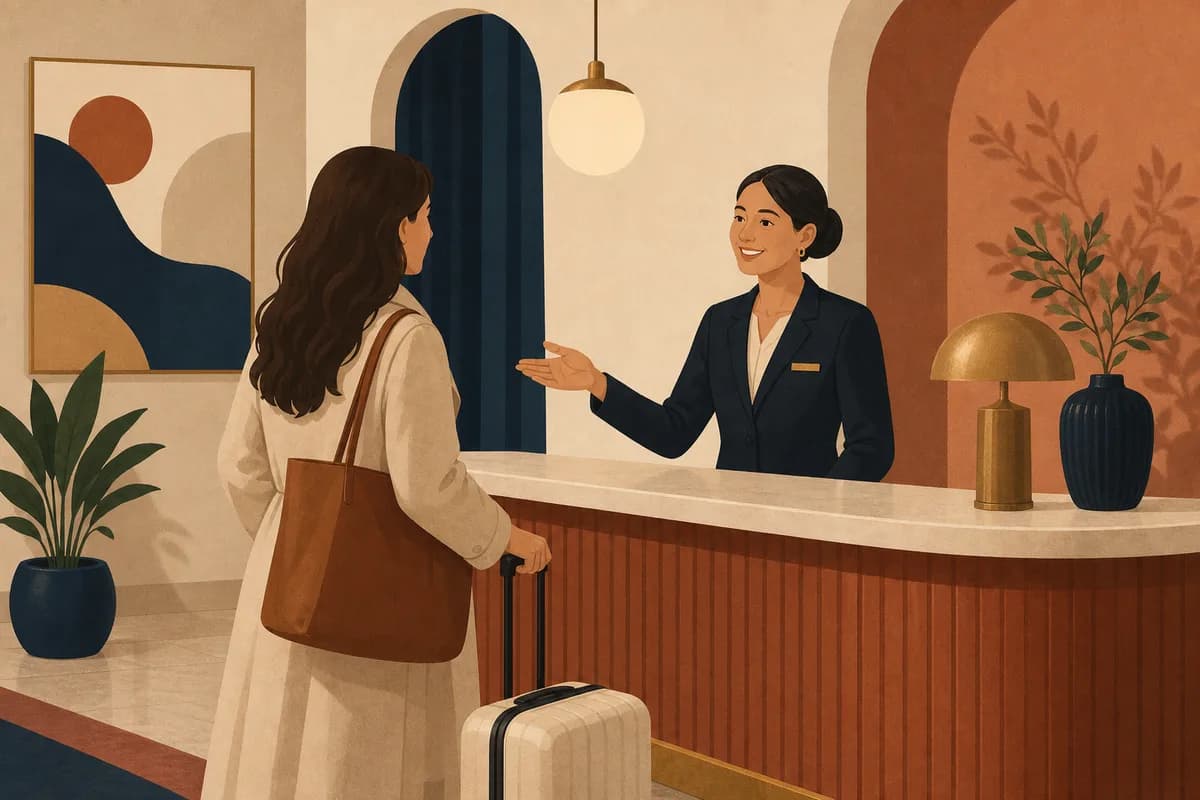
You know the greeting by heart. "Good evening, welcome to the Riverside, how may I help you?" comes out fluent, without a stumble. The problem starts with the next line, when the guest answers in a Scottish accent or an Indian accent, talking fast, swallowing half the sounds, and you catch three words out of the fifteen they just said.
That's where front desk staff, servers and housekeeping really struggle. Learning set phrases is easy, a few weeks and you can say them. Being able to understand what the guest says back is what decides whether you stand at the desk with confidence or stand there with a forced smile before turning to call the manager.
This article follows that exact order. Vocabulary is broken down by the department you work in, and for every scripted line you say, there are two or three lines guests actually say back, marked where they swallow sounds. The end of the article covers the hardest part, which almost no material teaches: catching room numbers, times, and guest names spelled out over the phone.
- Why hotel and restaurant English is hard in its own way
- Front desk vocabulary, check-in and check-out
- Housekeeping and maintenance vocabulary
- Restaurant service and order-taking vocabulary
- Handling guest complaints
- Positions, departments and shifts
- Catching room numbers, times and guest names
- Common mistakes
- Three stages for people working in service
- Frequently asked questions
Why hotel and restaurant English is hard in its own way
The vocabulary in this industry isn't hard. Most of it is everyday words: room, key, bill, table, clean. There are no long Latin roots like in medicine, no tangled sentence structures like in law. Read on paper, you understand almost all of it, and that's exactly the trap.
The difficulty lies in three other places. First is accent: your guests come from everywhere, and most aren't native speakers. Second is speed combined with emotion — a guest who just got off a midnight flight or is annoyed about a noisy room isn't going to slow down for you. Third, you only get to ask them to repeat once, twice at most, before the guest starts getting irritated.
There's another layer on top: the same thing has two or three different names depending on the region. Bill or check, rota or roster, lift or elevator, starter or appetizer. You learn one, the guest uses the other, and in that three-second pause the guest immediately reads that you didn't understand. So most of this article doesn't stop at what a word means, it focuses on what that word actually sounds like when a guest really says it.
Front desk vocabulary, check-in and check-out
The front desk is where your English gets tested most intensively: every guest interaction is a conversation with numbers, names and money, and you can't afford to mishear any of the three. Here's the core vocabulary set.
| Term / phrase | Phonetic | Meaning | Example sentence |
|---|---|---|---|
| reservation | /ˌrezərˈveɪʃn/ | a booking, a reservation slip | "Do you have a reservation with us tonight?" |
| booking | /ˈbʊkɪŋ/ | a booking (common term in the UK, Australia) | "The booking came through this morning." |
| walk-in | /ˈwɔːk ɪn/ | a guest who arrives without a reservation | "Two walk-ins at the desk, do we still have a twin?" |
| check-in | /ˈtʃek ɪn/ | checking in | "Check-in is from two, but I can store your bags." |
| check-out | /ˈtʃek aʊt/ | checking out | "Check-out is at eleven, is that alright for you?" |
| early check-in | /ˈɜːrli tʃek ɪn/ | checking in earlier than the standard time | "Early check-in depends on availability, let me look." |
| late check-out | /leɪt tʃek aʊt/ | checking out later than the standard time | "Late check-out until two, there is a small charge." |
| confirmation number | /ˌkɒnfərˈmeɪʃn ˈnʌmbər/ | booking confirmation number | "Have you got the confirmation number in your email?" |
| deposit | /dɪˈpɒzɪt/ | a deposit | "We take a deposit on the card, it is released at check-out." |
| incidentals | /ˌɪnsɪˈdentlz/ | extra in-room charges (minibar, laundry) | "The card is only to cover incidentals." |
| key card | /ˈkiː kɑːrd/ | the magnetic key card that opens a room | "Tap the key card here to call the lift." |
| room rate | /ˈruːm reɪt/ | the price of a room per night | "The room rate includes breakfast for two." |
| occupancy | /ˈɒkjəpənsi/ | room occupancy rate | "We are at ninety percent occupancy this weekend." |
| fully booked | /ˈfʊli bʊkt/ | no rooms left | "I am sorry, we are fully booked tonight." |
| overbooking | /ˌoʊvərˈbʊkɪŋ/ | accepting more bookings than there are actual rooms | "Overbooking on a Friday always ends in an argument." |
| no-show | /ˈnoʊ ʃoʊ/ | a guest who booked but never arrived | "Two no-shows last night, charge one night to the card." |
| upgrade | /ˈʌpɡreɪd/ | a room upgrade | "I have upgraded you to a sea view, no extra charge." |
| folio | /ˈfoʊlioʊ/ | a room's statement of charges | "I will print your folio, please check the charges." |
| settle the bill | /ˈsetl ðə bɪl/ | to pay the bill | "How would you like to settle the bill, card or cash?" |
| left luggage | /left ˈlʌɡɪdʒ/ | a place to store luggage | "You can leave your bags in left luggage until three." |
| wake-up call | /ˈweɪk ʌp kɔːl/ | a phone call to wake a guest | "Would you like a wake-up call in the morning?" |
| shuttle | /ˈʃʌtl/ | a shuttle bus | "The airport shuttle leaves on the hour from the lobby." |
The vocabulary above is the part you say. What you hear back is completely different, because guests don't answer in the full sentences found in textbooks. The table below pairs each scripted line you say with what guests actually say back, marking where they swallow sounds.
| What you say | What the guest actually says back |
|---|---|
| "Do you have a reservation?" | "Yeah, should be under Whitfield." (should be runs together into shd-be) / "We booked through one of those sites." (through one of becomes throo-wə-nəv) / "My assistant sorted it, I have not got the number on me." (have not got becomes havn-gɒt) |
| "Check-in is from two o'clock." | "Any chance of getting in earlier? We have been up since four." / "That is fine, can we leave the bags?" (can we becomes c'nwi) / "We will come back after lunch then." |
| "Could I take a card for incidentals?" | "What is that for exactly?" (What is that becomes wots-that) / "Will it be charged now or later?" / "Can I leave cash instead?" |
| "Breakfast is served until half ten." | "Is it included in the rate?" (Is it becomes izit) / "Where is it, down here?" / "Do you do anything gluten-free?" (Do you becomes d'you) |
| "Would you like a wake-up call?" | "No, we are alright, thanks." / "Yeah, half six if you can." (half six means half past six) / "Just for him, not for me." |
| "How was your stay with us?" | "Lovely, thanks." / "Bit noisy the first night, otherwise fine." (a mild complaint, very easy to miss) / "Could I get a receipt for the company?" |
The last line in the table is the most noteworthy. "Bit noisy the first night, otherwise fine" sounds like a compliment, but it's a softened complaint, and at many hotels this is exactly the moment you should apologize and log it. Missing that nuance means missing the substance.
And here's a full check-in exchange, written at the actual rhythm guests really speak in, not the rhythm found in books:
You: Good evening, do you have a reservation with us?
Guest: Yeah, should be under Whitfield. (should be slurs into a very light sound, coming out almost like "yeah, shd-be under Whitfield")
You: Whitfield, could you spell that for me?
Guest: W-H-I-T-F-I-E-L-D. (nine letters in about two seconds, the easiest spot in the whole exchange to lose track of)
You: Thank you, I have got you for three nights in a twin room.
Guest: That is right, and we asked for a high floor if you have got one. (we asked for becomes "wi-ast-fə", the k sound almost disappearing)
You: Let me see what I can do. Could I take a card for incidentals?
Guest: Do you need it now, or can I settle everything at the end? (Do you becomes d'you, can I becomes c'n-I)
The guest's four lines in this exchange contain exactly four kinds of difficulty: a slurred phrase, a string of spelled-out letters, a dropped consonant, and a two-part question. None of the lines use an unusual word. All the difficulty lies in the sound, and that's why reading more vocabulary lists doesn't solve this problem.
Housekeeping and maintenance vocabulary
Housekeeping talks to guests less than the front desk does, but listens more over radios and internal phones, the two channels with the worst sound quality in the hotel. Here's the vocabulary set you hear dozens of times every shift.
| Term / phrase | Phonetic | Meaning | Example sentence |
|---|---|---|---|
| housekeeping | /ˈhaʊskiːpɪŋ/ | the housekeeping department | "Housekeeping, may I come in?" |
| room attendant | /ˈruːm əˈtendənt/ | a room attendant, a housekeeper | "Each room attendant does about fourteen rooms a shift." |
| make up the room | /meɪk ʌp ðə ruːm/ | to clean and make up the room | "Could you make up the room while we are at breakfast?" |
| turndown service | /ˈtɜːrndaʊn ˌsɜːrvɪs/ | an evening turndown, preparing the room for the guest to sleep | "Turndown starts at six on the executive floors." |
| do not disturb | /duː nɒt dɪˈstɜːrb/ | the do-not-disturb sign | "Four-oh-nine still has do not disturb on the door." |
| amenities | /əˈmiːnətiz/ | complimentary items in the room | "Restock the amenities, she has used both shampoos." |
| linen | /ˈlɪnɪn/ | linens: sheets, pillowcases, duvet covers | "Fresh linen goes on every third night for stayovers." |
| change the sheets | /tʃeɪndʒ ðə ʃiːts/ | to change the sheets | "Change the sheets in twelve-oh-six, there is a stain." |
| stain | /steɪn/ | a stain | "There is a stain on the carpet by the window." |
| vacant | /ˈveɪkənt/ | a vacant room | "It shows as vacant clean on the system." |
| occupied | /ˈɒkjupaɪd/ | a room currently in use by a guest | "Do not go in, it is still occupied." |
| stayover | /ˈsteɪoʊvər/ | a room where the guest is staying on, not checking out | "Stayovers first, then the departures." |
| trolley | /ˈtrɒli/ | the housekeeping cart | "Do not leave the trolley blocking the fire door." |
| vacuum | /ˈvækjuːm/ | to vacuum | "Vacuum the corridor after the last check-out." |
| maintenance request | /ˈmeɪntənəns rɪˈkwest/ | a repair request | "Put a maintenance request in, the shower is dripping." |
| out of order | /aʊt əv ˈɔːrdər/ | a room or piece of equipment that's broken, unusable | "Three-oh-two is out of order until the air con is fixed." |
| lost and found | /lɒst ənd faʊnd/ | items guests have left behind | "A charger went to lost and found from eleven-twelve." |
| laundry | /ˈlɔːndri/ | laundry, the laundry service | "Laundry picked up before nine comes back the same day." |
| dry cleaning | /draɪ ˈkliːnɪŋ/ | dry cleaning | "Is the jacket dry cleaning or normal wash?" |
| minibar | /ˈmɪnibɑːr/ | the small drinks cabinet in the room | "Check the minibar before they check out." |
| deep clean | /diːp kliːn/ | a thorough clean | "That room needs a deep clean before we sell it again." |
Two words in this table cause the most confusion. "Vacant" is pronounced /ˈveɪkənt/ with the stress at the front; many Vietnamese speakers pronounce it /vəˈkænt/ and then think it's a different word when they hear a native speaker say it. And "out of order," said quickly, runs together into one block — the v sound of "of" links straight into "order," so the whole phrase sounds almost like "aʊ-tə-vɔː-dər." The first time, it's very hard to pick apart into four separate words.
Restaurant service and order-taking vocabulary
Taking orders is the hardest listening situation in the whole industry, for three reasons at once: the dining room is noisy, guests talk while looking at the menu instead of looking at you, and one misheard detail means the wrong dish comes out. If that detail is an allergy, the consequences don't stop at having to remake the dish.
| Term / phrase | Phonetic | Meaning | Example sentence |
|---|---|---|---|
| course | /kɔːrs/ | a course in a meal sequence | "Are you ready for your main course?" |
| starter | /ˈstɑːrtər/ | a starter (British, Australian term) | "Two starters to share, then the mains together." |
| appetizer | /ˈæpɪtaɪzər/ | a starter (American term) | "Can I get you an appetizer while you look at the menu?" |
| à la carte | /ˌɑː lɑː ˈkɑːrt/ | ordering individual dishes from the menu | "Breakfast is buffet or à la carte, whichever you prefer." |
| set menu | /set ˈmenjuː/ | a fixed multi-course menu | "The set menu is three courses for forty-five." |
| special | /ˈspeʃl/ | the dish of the day | "Let me run you through tonight's specials." |
| allergy | /ˈælərdʒi/ | a food allergy | "Any allergies at the table I should know about?" |
| intolerance | /ɪnˈtɒlərəns/ | an intolerance (dairy, gluten) | "It is an intolerance, not a full allergy." |
| gluten-free | /ˌɡluːtn ˈfriː/ | free of gluten | "The pasta can be done gluten-free, it takes a bit longer." |
| on the side | /ɒn ðə saɪd/ | served separately, on the side | "Could I have the dressing on the side?" |
| medium rare | /ˈmiːdiəm ˈreər/ | medium rare | "How would you like the steak, medium rare?" |
| well done | /wel ˈdʌn/ | well done | "His is well done, mine is blue." |
| still or sparkling | /stɪl ɔːr ˈspɑːrklɪŋ/ | still or sparkling water | "Still or sparkling water for the table?" |
| top up | /tɒp ʌp/ | to refill | "Shall I top up your glass?" |
| clear the plates | /klɪər ðə pleɪts/ | to clear the plates | "Can I clear these for you?" |
| split the bill | /splɪt ðə bɪl/ | to split the bill | "Would you like to split the bill or keep it on one card?" |
| service charge | /ˈsɜːrvɪs tʃɑːrdʒ/ | a service charge already included in the bill | "There is a ten percent service charge on parties of six." |
| corkage | /ˈkɔːrkɪdʒ/ | a fee for opening wine a guest brings themselves | "Corkage is fifteen a bottle if you bring your own." |
| run the food | /rʌn ðə fuːd/ | to carry food from the kitchen to the table | "Can someone run the food to table twelve?" |
| eighty-six | /ˌeɪti ˈsɪks/ | out of stock, stop selling that dish | "We are eighty-six on the sea bass." |
| to take away | /tə teɪk əˈweɪ/ | to pack up to go | "Could we get the rest to take away?" |
The word "eighty-six" is kitchen slang, not found in textbooks, but you'll hear it in your very first week working in an English-speaking kitchen. If you work more on the kitchen side than the floor, a more in-depth vocabulary set is in the article kitchen-specific English.
And here's the part you hear back, paired with the line you say:
| What you say | What the guest actually says back |
|---|---|
| "Are you ready to order?" | "Give us another minute." (Give us runs together into "gi-vəs") / "What is the fish today?" / "Can you run me through the specials again?" (run me through becomes "rən-mi-throo") |
| "How would you like your steak?" | "Medium rare, please." / "As rare as you can do it." / "Medium, but no pink at all." (this one is self-contradictory, you have to ask again to clarify) |
| "Any allergies I should know about?" | "She cannot do dairy." (cannot do becomes "cn-do") / "I am coeliac." (/ˈsiːliæk/, the guest names the condition rather than saying the word gluten) / "Just no nuts anywhere near it." |
| "Still or sparkling?" | "Tap is fine." (free tap water; said fast it sounds a lot like "top") / "Sparkling, a big one." / "Just tap for now, thanks." |
| "Can I get you anything else?" | "Just the bill when you are ready." / "Could we get the check?" (an American guest — "check" here means the bill) / "Two coffees and then we will go." |
| "Would you like to split the bill?" | "All on this one." (accompanied by handing over a card) / "Separate, if that is alright." / "Can you do it three ways?" |
Pay attention to the phrase "Tap is fine." British guests say this constantly; it means they want free tap water, and heard quickly, "tap" and "top" sound almost identical to a Vietnamese ear. Mistakenly selling a bottle of mineral water to a guest who just declined to pay for water is a small kind of mistake, but it ruins the whole meal.
Handling guest complaints
Complaints are the hardest listening situation psychologically. Guests talk faster than usual, sentences get longer, and emotion distorts the sound. At the same time you have to listen and think about how to handle it at once, so the part of your brain devoted to listening gets split in two.
| Term / phrase | Phonetic | Meaning | Example sentence |
|---|---|---|---|
| complaint | /kəmˈpleɪnt/ | a complaint | "We had a noise complaint from the room below." |
| unacceptable | /ˌʌnəkˈseptəbl/ | unacceptable (a word guests often use) | "This is completely unacceptable." |
| I do apologise | /aɪ duː əˈpɒlədʒaɪz/ | I sincerely apologize | "I do apologise for the inconvenience." |
| inconvenience | /ˌɪnkənˈviːniəns/ | an inconvenience | "Sorry for the inconvenience, it will not happen again." |
| bear with me | /beər wɪð miː/ | please wait a moment for me | "Bear with me while I check the system." |
| look into it | /lʊk ˈɪntuː ɪt/ | to check, to look into it further | "Let me look into it and call you back in five minutes." |
| sort it out | /sɔːrt ɪt aʊt/ | to resolve it completely | "I will get that sorted out straight away." |
| duty manager | /ˈdjuːti ˈmænɪdʒər/ | the manager on duty | "Let me get the duty manager for you." |
| escalate | /ˈeskəleɪt/ | to bump the matter up to someone higher | "If he asks for the manager again, escalate it." |
| compensate | /ˈkɒmpenseɪt/ | to compensate | "We compensated them with dinner for two." |
| goodwill gesture | /ˌɡʊdwɪl ˈdʒestʃər/ | a goodwill gesture | "Send a fruit plate up as a goodwill gesture." |
| waive the charge | /weɪv ðə tʃɑːrdʒ/ | to waive that charge | "I will waive the late check-out charge this time." |
| refund | /ˈriːfʌnd/ | a refund | "A full refund has to go through the manager." |
| move you to another room | /muːv juː tə əˈnʌðər ruːm/ | to move a guest to another room | "I can move you to a quieter room on the fourth floor." |
| follow up | /ˈfɒloʊ ʌp/ | to check back afterward | "Follow up with her before she checks out tomorrow." |
| review | /rɪˈvjuː/ | a public review online | "One bad review on a Monday and the whole week looks off." |
A real complaint, transcribed at the exact rhythm it was spoken:
Guest: I have been in the room twenty minutes and the air con does not work. (does not work slurs into "dəzn-wɜːk")
You: I am very sorry about that. Let me get someone up to look at it straight away.
Guest: I do not want someone looking at it, I want a room that works. (I do not want becomes "aɪ-dəwɒn", the remaining three words run together in one breath)
You: Of course. Bear with me one moment while I check what else we have free.
Guest: And we have got an early start, so I cannot be moving rooms at midnight. (we have got an becomes "wiv-gɒ-tən")
You: Understood. I do apologise for the inconvenience. I can move you now, fourth floor, quieter side, and I will have your bags brought up.
The most important sentence in this exchange is the guest's third line. "I cannot be moving rooms at midnight" isn't just a complaint, it's a condition: the guest accepts changing rooms, but it has to happen right now. If you miss that clause and offer to move them tomorrow morning, you have just offered exactly the thing the guest ruled out, and the conversation escalates another notch.
This is also why the vocabulary table alone isn't enough. You could know all sixteen words in the table above and still mishandle this situation, just because the four words "cannot be moving rooms" flew past your ear too fast.
Positions, departments and shifts
This set of vocabulary rarely comes up in front of guests, but it comes up constantly internally: shift briefings, scheduling, handovers, and in job interviews at international hotels.
| Term / phrase | Phonetic | Meaning | Example sentence |
|---|---|---|---|
| front office | /frʌnt ˈɒfɪs/ | the front-of-house division: reception, reservations, switchboard | "She has been in front office for six years." |
| front of house | /frʌnt əv ˈhaʊs/ | the area where guests are present | "Front of house means uniform on and phone away." |
| back of house | /bæk əv ˈhaʊs/ | the internal area, off-limits to guests | "Staff canteen is back of house, through that door." |
| F&B | /ˌef ənd ˈbiː/ | the food and beverage department | "F&B covers the restaurant, the bar and room service." |
| concierge | /ˌkɒnsiˈeəʒ/ | staff who assist guests beyond the room itself | "Ask the concierge, he can book the tour for you." |
| porter | /ˈpɔːrtər/ | a luggage porter | "The porter will bring your bags up in a moment." |
| host | /hoʊst/ | staff who greet and seat guests | "The host will seat you as soon as a table is free." |
| shift | /ʃɪft/ | a work shift | "I am on the late shift all week." |
| split shift | /splɪt ʃɪft/ | a broken shift, worked in two blocks in a day | "It is a split shift, ten to three then six to eleven." |
| roster | /ˈrɒstər/ | the shift schedule (Australia, US) | "The roster goes up on Thursday." |
| rota | /ˈroʊtə/ | the shift schedule (UK) | "I am not on the rota this Sunday." |
| briefing | /ˈbriːfɪŋ/ | a short meeting at the start of a shift | "Briefing is at ten to three, do not be late." |
| handover | /ˈhændoʊvər/ | a shift handover | "Anything on handover for the night team?" |
| cover | /ˈkʌvər/ | a guest served, or covering someone else's shift | "We did two hundred covers on Saturday." / "Can you cover my shift?" |
| overtime | /ˈoʊvərtaɪm/ | working extra hours | "There is overtime going this weekend if you want it." |
| peak season | /piːk ˈsiːzn/ | the busiest season | "Peak season we run near full occupancy every night." |
| probation | /prəˈbeɪʃn/ | the probationary period | "You are on three months probation to start." |
The word "cover" has two completely different meanings within the same industry, and both get used every day. "Two hundred covers" means two hundred guests served, "cover my shift" means working someone else's shift. Context decides, but when you hear it fast in a noisy dining room, context won't save you either if you're not already familiar with both.
Catching room numbers, times and guest names
This is the part almost no material in the industry teaches, yet it's where new staff make the costliest mistakes. All three kinds of information are short, impossible to guess from context, and pass through your ear in under a second.
Room numbers and fast-spoken numbers
Room numbers can be read several ways. Room 415 might be "four fifteen" or "four one five." Room 405 is almost always "four-oh-five," because a zero within a number sequence is read as "oh," rarely as "zero." Room 1102 becomes "eleven-oh-two." You need to get comfortable with all three styles, because every hotel and every guest picks a different one.
The pair that causes the most accidents is still fifteen and fifty, thirteen and thirty, nineteen and ninety. The distinguishing point is the stress, not the final sound: fifTEEN stresses the second syllable, FIFty stresses the first. When a guest talks fast, the final sound nearly disappears and stress is the only clue left. This directly affects the room rate, the size of the party, and which room number you hand a key card for.
Time
"Half ten" in British English means ten thirty, not nine thirty the way many learners infer from German or Dutch. "Quarter to three" is 2:45. "Ten to three" is 2:50, and if your ear drops the word "to," you understand it as 3:10, off by twenty minutes.
The most dangerous pair is "eight thirty" and "eight thirteen," which differ by exactly one very faint final sound. For a guest booking an airport transfer, mishearing one of these means the guest misses their flight, and that's the kind of mistake the hotel has to compensate for.
Guest names spelled out over the phone
English letters read out fast over the phone are the harshest listening test in the trade. B, V and P sound almost the same when the signal is weak. So do M and N. And A, E and I are ones Vietnamese speakers often confuse, because the name of the letter doesn't match the sound that letter makes within a word.
The approach experienced staff take is simple: lead the exchange actively instead of trying to catch every sound. "Could you give me that letter by letter?" to get the guest to slow down, then read it back for the guest to confirm, using the NATO alphabet if needed: "A for Alpha, B for Bravo, P for Papa." Saying it once and getting the guest's confirmation is still faster than correcting a reservation with the wrong name on it.
How to make this vocabulary actually sink into your ear
The five tables above add up to nearly a hundred entries. Reading through them once doesn't take much time, but a week later you'll only remember a portion, and within that portion only a few words will register fast enough when a guest talks quickly. That's normal, because reading comprehension and real-time listening are two different skills, and this industry only pays for the second one.

The most effective memory mechanism is the one you've already been through on the job: a word you once misheard and got corrected on right there, you remember forever. Making a mistake and catching it yourself is what etches into memory, while skimming just washes away. Dictation listening practice recreates that exact loop at home: listen to a sentence, transcribe it by ear, check it against the transcript, and see exactly where you fell short.
Take the example "we asked for a high floor" from the check-in exchange above again. Spoken naturally, the k sound in "asked" links into "for" and almost vanishes, so the whole phrase sounds like "wi-ast-fə." Beginners often transcribe it as "we ask for," losing the past-tense marker entirely, and in this line of work that past tense matters a lot, because it tells you the guest made the request back when they booked. This phenomenon has a name and follows rules — WELE covers it separately in the article on connected speech.
The specific transcription process — how many times to transcribe, when you're allowed to check the transcript — is in the article 5 steps to effective dictation listening. Applying that exact process to a hotel dialogue is the closest you can get to real shift practice without actually standing at the desk.
When choosing what to listen to, start at a pace you can manage instead of diving straight into noisy dining-room audio. WELE's podcast library has plenty of topics to choose from, and if you don't know where you currently stand, the free listening level test gives you a clearer starting point than guessing. If you want to know how far your general vocabulary reaches before pouring effort into specialized terms, there's a separate vocabulary test.
Every row in the five tables above comes with a real sentence instead of just a meaning, and that's deliberate. You remember "corkage" better when it sits inside the sentence "corkage is fifteen a bottle" than when it stands alone on a flashcard. The reasoning behind this approach is in the article vocabulary in context versus flashcards.
And if your schedule is a split shift, a block in the morning and a block in the evening, then cramming two hours on the weekend isn't as effective as fifteen minutes while waiting between shifts. That kind of scheduling is covered in the article learning English 15 minutes a day.
Common mistakes
The mix-ups below repeat most often among Vietnamese staff working in international hotels and restaurants.
- Confusing entrée between American and British usage. In the US, entrée means the main course. In the UK, Australia and France, entrée means the starter. Mishearing this means bringing the wrong dish to the table, so when a guest uses this word and you're not sure, asking a short follow-up question is still safer.
- Confusing complimentary with complementary. "Complimentary breakfast" means a free breakfast, nothing to do with a compliment. The two words are pronounced almost identically, differing only in spelling, so you have to rely entirely on context.
- Hearing "check" as a request to inspect something. An American guest saying "Can we get the check?" means asking for the bill. A British guest says "Can we get the bill?" for the same thing. Knowing both terms saves you those few confused seconds.
- Mispronouncing suite. "Suite" is pronounced /swiːt/, exactly like "sweet," not like "suit." Getting this word wrong at the front desk is one of the things guests notice right away.
- Answering a choice question with yes. "How would you like your steak?" and "Still or sparkling?" are both choice questions, not yes-or-no questions. This is a reflex error that happens when you haven't finished hearing the sentence and guess blindly.
- Using overly blunt phrasing in tense situations. "Please wait a minute" is grammatically correct but sounds dry when a guest is upset. "Bear with me one moment" or "Let me look into that for you" mean the same thing but sound far softer, and in service work, tone is part of the job.
- Learning vocabulary while skipping numbers and proper names. This is the biggest mistake. You can memorize all five tables above and still hand over the wrong room key because you heard "fifteen" as "fifty."
Three stages for people working in service
The vocabulary tables above are just the raw material. What turns it into a working skill is a training sequence that matches how a hotel actually runs, and it only has three stages.
- Stage one, read SOPs and reservation forms in English. Every department has a written procedure, and a procedure written in proper industry English is tighter than any textbook. Each week, take one SOP from the exact department you work in, read it aloud, then boil it down into six sentences you'll actually say to a guest when running that procedure. Do the same once more with a confirmation email or a booking form, underline every information field, and read each one aloud.
- Stage two, understand requests from guests of every nationality. This is the longest stage and also the one that separates people out. Each week, transcribe a sixty-second clip of natural spoken English, prioritizing clips with multiple speakers and different accents. Once transcribed, circle every number, proper name and time, then re-listen to exactly those spots, because that's the category of information this job doesn't let you get wrong.
- Stage three, handle complaints politely. Moving from stage two to stage three means moving from listening to speaking under pressure. Each week, take one real complaint you ran into during a shift and build a response in three steps: a brief apology, restating exactly the issue the guest raised, then a specific action with a timeframe. Record yourself until you can say it in one smooth breath, because once a guest is upset you no longer have time to translate in your head.
There are plenty of self-study resources for this industry, but most are course advertisements. The four resources below give you the real English of the trade.
- SetupMyHotel (setupmyhotel.com): a free library of SOPs organized by department, complete with phone scripts and forms, exactly the kind of text you read during a shift rather than dialogue built for a classroom.
- Hospitality Daily (podcast.hospitalitydaily.com): short daily episodes interviewing people currently working in hotels, suited for listening a little every day instead of cramming on weekends.
- EHL Insights (insights.ehl.edu): the site of hospitality school EHL, with tightly written, well-structured industry analysis, useful for building management-level vocabulary when you want to move beyond your current position.
- Hospitality Net (hospitalitynet.org): an industry news platform running since 1994, free, with news and opinion pieces on hotel operations, useful for getting used to how the industry names the very work you do.
Every stage shares the same core task: take a piece of real spoken English, transcribe it, check it against the original. Dictation practice doesn't replace an actual shift, but it lets you mishear at home instead of mishearing in front of a guest.
Frequently asked questions
Where should you start when learning specialized hotel and restaurant English?
Start with the department you're currently working in, not page one of a textbook. If you work the front desk, learn the front-desk table first, then immediately practice listening to room numbers and spelled-out names, because those are the two things you'll use in your very first shift.
How is hotel communication English different from everyday conversational English?
It differs in being more one-directional than two-directional. The part you say is fairly fixed and can be memorized, while what guests say back is completely open, every accent and every speed. So effort should go into listening skills rather than into learning more set phrases.
What level of English do you need to work hotel reception?
Specific requirements vary by place, but what gets tested in the interview is usually listening reflexes, not a certificate score. If you want to know where you stand before applying, a listening test gives you a faster answer than guessing.
Is memorizing set phrases enough to do the job?
Enough for the first line of every conversation, not enough for the second. A script gets you the opening, but the rest of the conversation is led by the guest, and nobody hands you the guest's lines in advance.
What if a guest's accent is hard to understand?
The only way is to listen to many different accents before meeting them in real life, so your ear gets used to the same word ringing out in several different ways. Alongside that, keep a polite ready-made follow-up question on hand, such as "Sorry, could you say that again a little slower?", said naturally rather than hesitantly.
Should you learn vocabulary by department or by situation?
By department for a foundation, then by situation to make it usable. Vocabulary tables help you recognize words, while full dialogues, like the check-in and complaint exchanges above, are what actually teach you the order lines appear in and where you need to react.
The nearly hundred vocabulary entries across the five tables above are the easy part. The hard part is catching them when a guest talks fast, and the way to close that gap is transcribing sentence by sentence until your ear catches the spots where you still fall short. If you want to train that way systematically, the course packages are on WELE's pricing page.
If you work in the kitchen, see kitchen-specific English; if you work in tours and travel, see tourism-specific English. The remaining fields are in the roundup article specialized English.
