Steps to Improve Your English

Foreword
Talking with friends who share the same outlook, we've noticed there are 2 ways to help [a large number of] Vietnamese people absorb the best of what the world has to offer
- One is to translate valuable books from foreign languages into Vietnamese
- Two is to spread foreign language skills among Vietnamese people (the most important of which is English)
These two approaches must be carried out at the same time, in parallel, and supporting each other. Since I see learning a foreign language as a hobby (and because of that, I'm constantly thinking about and improving methods) plus I have a long-term plan to send talented Vietnamese people abroad for training, I focus my time on developing and sharing the optimal method for learning English for young people.
The people I want to reach are those who wish to raise their English ability, who want to learn English for the long haul, and who I hope will one day love English the way I love it ^_^. English is an extremely interesting and logical language — it didn't become the most widely used language in the world for no reason!!
What I share here can't replace English centers or extra classes. Please think of this article as supplementary material that you can use to strengthen your English ability every day, to make learning English more enjoyable. It will help you learn actively (active learning), so that going to extra classes becomes just a chance to ask teachers about the things you don't yet know, instead of going there to listen to teachers lecture!
OK, that was a long intro, let's get started!
After I wrote the note on "Using BBC Learning English to improve your English level," I got a huge response from young people who are putting in their best effort to improve their foreign language ability (more than 1.6k shares as of now). (link http://goo.gl/RiZa5R)
That note succeeded in introducing the website and how to use the most useful programs from BBC Learning English. However, there are 2 things the note didn't address, which I'll cover in this note:
- Orientation on the steps for learning English (an answer to the many questions of "Where should I start?")
- Building a weekly interactive English program so that people who are new to learning English can improve their ability in a disciplined way (step 4a)
Steps for learning English
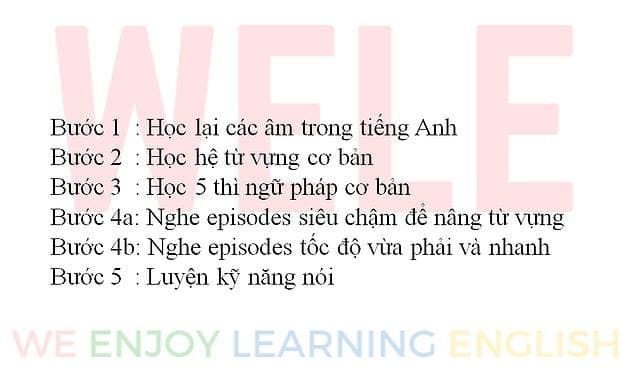
Actually, I've been learning English since I was young (from around 3rd grade), but I didn't study in a focused way and only started studying seriously in 12th grade and my first year of university, before going to the UK. So I tried learning another foreign language so I could put myself in your shoes. From that, I worked out five basic steps for learning a foreign language (and specifically in this case, English) that you can use as a reference:
Step 1: Relearn the sounds of English, and the similarities and differences with the sounds/syllables of Vietnamese
Step 2: Learn the basic vocabulary system. I encourage you to learn and memorize the 3000 Oxford Words (definitions and correct pronunciation. Note that at this step, once you already know how to pronounce, you must pronounce these 3000 words correctly) http://www.oxfordlearnersdictionaries.com/wordlist/english/oxford3000/
Step 3: Learn the 5 basic grammar tenses: present simple, present continuous, present perfect, past simple and future simple; for each tense learn 3 forms: affirmative, negative and question. (Studying just the textbook is enough, no need for more!)
Step 4a: Listen to super-slow episodes to build up vocabulary
Step 4b: Listen to episodes at a moderate and fast pace
Step 5: Practice speaking skills
Step 1: the most important thing when learning a language is that you have to start by learning the sounds (vowels and consonants) of the new language, and the similarities and differences between those sounds and the sounds you already know (that is, Vietnamese sounds). For each sound, you have to watch the native speaker's mouth shape and how they use their breath when pronouncing it, to make sure you can pronounce it as accurately as possible.
On YouTube there are some pretty good videos teaching pronunciation that you can follow to get familiar with standard English sounds. However, I've noticed that in most of these videos, the instructor pronounces the sound for you to hear and asks you to imitate it, even though not everyone has that ability. If there's such a thing as a "knack" for languages, this is probably the only one — that is, some people have the ability to hear and imitate, while others don't. However, even for those who are "least gifted" at it, as long as you focus a lot of time on mouth shape and tongue position, I can guarantee you'll be able to pronounce it correctly.
While teaching some close friends and cousins to pronounce English, I worked out the interesting, systematic and logical nature of English sounds + mouth shape (+ tongue) for correct pronunciation. This isn't something that can just be written down, so I'll have to make a video to share with everyone based on http://www.bbc.co.uk/worldservice/learningenglish/grammar/pron/sounds/
Since I lack experience making vlogs, please be patient and wait a bit longer :">. Here's the first video https://www.youtube.com/watch?v=llcQpxTE-_o&ab_channel=WELEWeEnJoyLearNingEngLish
Notably, recently the phone app ELSA has won many technology awards for helping people train their pronunciation skills. If you use it and find it effective and want to buy the product, remember to use the discount code WELEVN https://elsaspeak.com/inf/welevn/
Step 4: Listening skills (step 4) are split into 2 steps, 4a and 4b.
Step 4a: When you're just starting to learn a new language, because your vocabulary is limited and your ears haven't been trained to hear fast-paced conversation, the best thing to do is listen to slow and super-slow conversations so you can learn words.
Step 4b: Once your level has reached a certain point, start switching to listening at a faster pace. I recommend starting with "The Flatmates," or if you're more confident, listen to "6 Minute English." I still listen to the 6 Minute English program to this day (download it to your phone and listen on the bus + metro) because it helps me keep up with information as well as broaden my knowledge on related issues. So even if you've already got a 6.5 in IELTS or higher, even if you've already gone to study in the UK, I still highly encourage you to listen to 6 Minute English.
Step 5: There are many viewpoints on learning a foreign language, and the one I follow is "learning a foreign language is like a child learning their mother tongue — you have to listen enough before you can start speaking." You can see this in how children who are talked to a lot by their parents learn to speak faster. Similarly, you need to listen to and learn enough words first, put words together into sentences, say sentences you've heard before, and gradually create your own sentences. For those of you who have gotten through step 4a, the best way to practice speaking is to talk with foreigners. The best opportunity is probably working as a tour guide. Just go along with friends who have more experience, and as you keep listening, you'll gradually start speaking. In Hanoi, I've found 2 really great groups: Hanoi Free Tourguide and HanoiKids.
https://www.facebook.com/hftgs?fref=ts https://www.facebook.com/hanoikids
Weekly interactive English listening program (step 4): WE ENJOY LEARNING ENGLISH (WELE)
When you're just starting to learn English listening, you'll probably get fairly discouraged, for a few reasons:
1. Not being able to catch the words in the dialogues. The reason is that when native speakers talk fast, they swallow sounds or link words together into chunks. If you've never heard that chunk before, it's completely understandable that you can't catch it. Back then I was once advised to learn English through songs or by watching movies. But in reality, songs are very hard to catch (because they slur and swallow sounds in all sorts of ways), and movies (especially American action movies) are even harder to pick up words from — you mostly watch for entertainment and understand mainly through the images, so I don't think the learning value is that big. For beginners, the most important thing is to listen to slow and super-slow conversations, so that through them you can get familiar with the language, listen closely, and learn vocabulary. That's why in the WELE program, every 4 weeks, we use 2 Spotlight English lessons (super-slow English + simple words), 1 Deep English lesson (slow, with complex words) and 1 6 Minute English lesson (fast, with simple words). Besides that, the program also has the WELE Tool to help with rewinding while doing dictation, and slowing down the speed if needed.
2. LACK OF MOTIVATION & LAZINESS. This is an age-old problem. What frustrates a teacher most is when you put in the effort to teach for free, and the learner is only excited for a few sessions and then that's it. Many people go to extra classes for a simple reason: they've already paid the money, so out of not wanting it to go to WASTE, they study. This is NOT the right motivation?!! That's why I want to build a program where you study because you LIKE it, because of your PROMISE to yourself, and because you're continuously ENCOURAGED to learn English. Only then would it be worthy of the effort and dedication I've put in.
So, I set up the WE ENJOY LEARNING ENGLISH program (https://www.facebook.com/groups/WELEVN/) starting from 12/5/2014, to create motivation for over 9000 young people in learning English.

Note: link to the original post https://www.facebook.com/notes/10207879666665210/)
