Common Struggles with Dictation Practice (Part 2)


On this page
Continuing on the topic of difficulties in dictation listening, this week I'll share methods for dealing with the remaining 3 difficulties, which are:
(3) Not being able to catch every word clearly;
(4) Hearing how a word is pronounced but not knowing how to write it,
(5) Not seeing progress or results.
Check out the methods below:
3. Not being able to catch every word clearly
Method:
Actually, not being able to catch every word is because your brain hasn't been trained to process information at the speed the audio is being spoken. If your processing speed is only 3 words a second while the audio is running at 6 words/second, your brain is very likely to overload.
So there are 2 ways to deal with this: one is to switch to slow playback mode (choose a slow listening source like Spotlight + reduce the speed - a tool already built into WELE); the other is to learn how to catch the important words. With WELE, the program encourages you to follow method one — as your brain comes to know more and more words and your processing speed gradually increases, you'll be able to hear whole sentences instead of having to catch word by word.
4. Hearing it but not knowing how to write that word
Method:
Try to write the word down exactly as you guess it; for example, for the word house, if what you hear is the sound "hau-sờ," then just write down "hau-sờ" — that way, when you hand in your work, you'll be able to see how you heard that word at the time, so you can correct it.
If you want to go further, you can use your smartphone's speech-to-text feature to say that exact sound back and have your phone write that sound out for you.
Sometimes you don't even need to know the meaning of the word to still write it correctly, thanks to the tools above. And the process of tracking down that difficult word will help you never forget it in the future.
That Eureka moment (when you realize what the word you couldn't catch actually is) brings a huge boost of positive energy for the day.
5. Not seeing progress or results from dictation practice
Method:
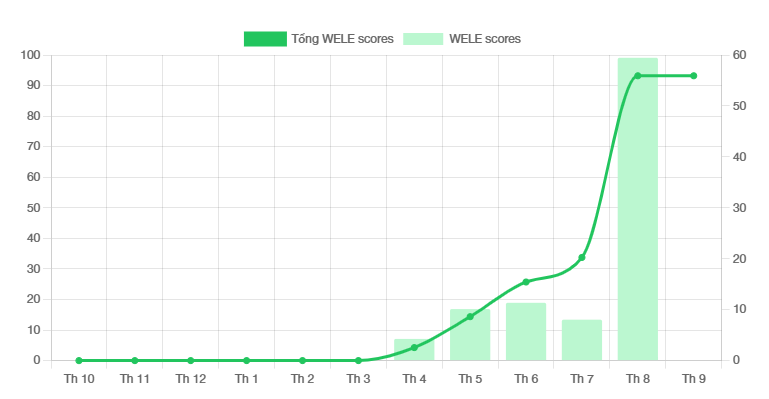
Measuring progress is always a headache for any method. With WELE, the program keeps a record of the number of words you catch in each episode, and when that number goes up, it means you're making progress. To find out how your score compares to TOEIC/IELTS benchmarks, check out the article "How Effective Is Learning with WELE".