Seasons in English: Fall vs. Autumn and the Idioms That Come With Them

On this page
- Table of the four seasons and pronunciation
- fall or autumn, which one to choose
- Why seasons aren't capitalized but months are
- in summer or in the summer
- Words that go with each season
- Seasonal idioms and what they really mean
- Talking about Vietnam's seasons in English
- Listening: when winter becomes winner, and other places seasons slip past your ear
- Quick questions about the four seasons
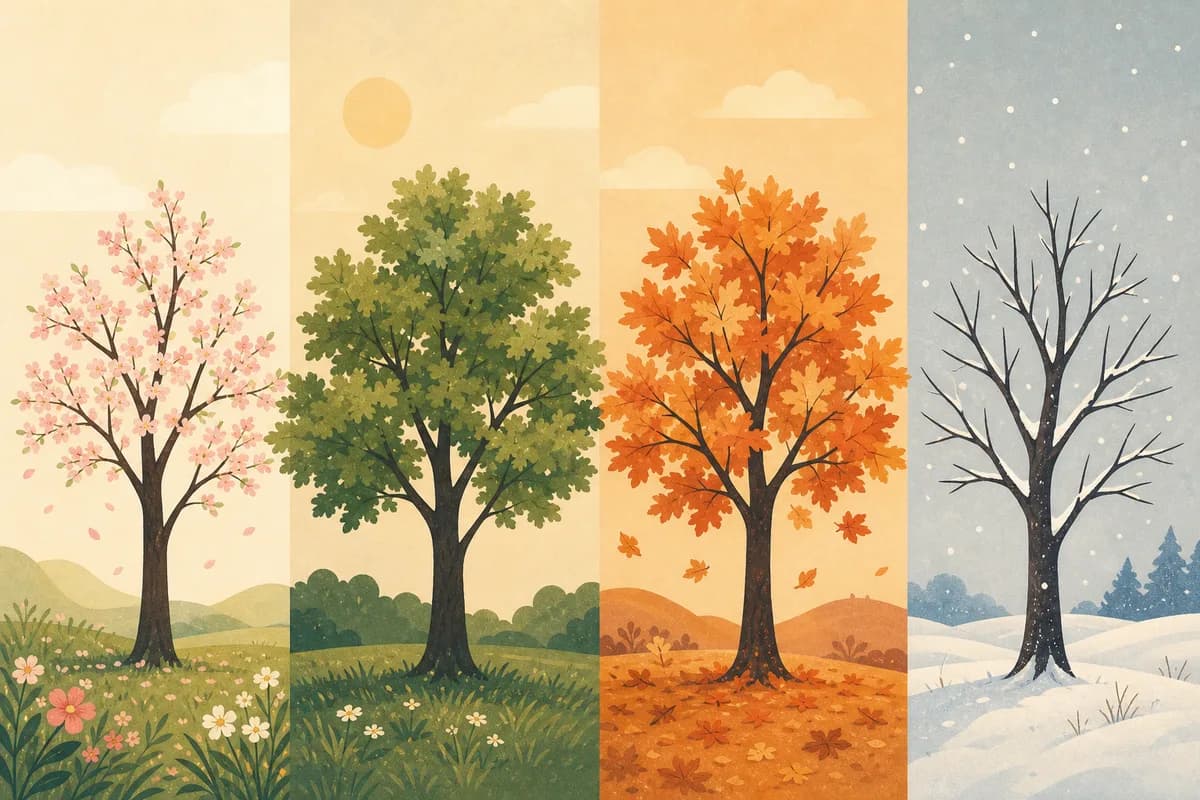
Four words. Spring, summer, autumn, winter. You probably memorized them back in fourth grade and never thought you'd need to read anything more about the topic.
Then you write an email to an American partner and hesitate between autumn and fall. You capitalize the word Summer because your head is still running on the rule for months and days of the week, and you get corrected. You want to say that Saigon only has two seasons and don't know what to call the rainy one. And when someone says "in the dead of winter," you understand every word and still aren't sure what they mean.
Four words are easy, but what surrounds them is what you actually use every day. This page goes through all of it: pronunciation of the four seasons, the fall versus autumn question, capitalization rules, phrases that go with each season, idioms with real meanings, how to talk about Vietnam's two seasons, and finally the spots where "season" tends to slip past your ear when you're listening.
- Table of the four seasons and pronunciation
- fall or autumn, which one to choose
- Why seasons aren't capitalized but months are
- in summer or in the summer
- Words that go with each season
- Seasonal idioms and what they actually mean
- Talking about Vietnam's seasons in English
- Listening: when winter sounds like winner, and other places season slips past your ear
- Quick questions about the four seasons
Table of the four seasons and pronunciation
| Season (Vietnamese) | English | IPA | Months usually counted (Northern Hemisphere) |
|---|---|---|---|
| Mùa xuân | spring | /sprɪŋ/ | March, April, May |
| Mùa hè | summer | /ˈsʌmə/ (British), /ˈsʌmər/ (American) | June, July, August |
| Mùa thu | autumn or fall | /ˈɔːtəm/ and /fɔːl/ | September, October, November |
| Mùa đông | winter | /ˈwɪntə/ (British), /ˈwɪntər/ (American) | December, January, February |
| Mùa (in general) | season | /ˈsiːzn/ | Used for all four, and for the rainy season, the dry season |
The months column above follows the meteorological way of dividing the year, which simply rounds each season to three months. The astronomical way is different: each season begins around the 20th or 21st of March, June, September, December, based on the equinoxes and solstices. Native speakers use both and usually don't specify which one they mean, so if someone tells you summer starts on June 21st, they're not wrong — they're just counting a different way. How the months themselves are named is covered in the article on months in English.
Two pronunciation details are worth pinning down right away. The final n in autumn is silent — the word is /ˈɔːtəm/, ending with closed lips. But in the adjective form autumnal /ɔːˈtʌmnəl/, the n comes back to life, the stress jumps to the second syllable, and the vowel changes too. Same root, two completely different faces.
The second detail is that spring begins with the three-consonant cluster /spr/. Vietnamese has no cluster like this at the start of a syllable, so learners automatically slip a vowel in the middle to make it easier to say. When speaking, listeners still understand you, but when listening, that same habit makes your ear drop the /r/ sound and mishear it as a different word.
fall or autumn, which one to choose
This is the most common question about seasons, and the short answer is: both are correct, they just differ by region and nuance.
| Word | Used mostly where | Nuance | Example |
|---|---|---|---|
| fall | US and Canada, in everyday speech | Ordinary, natural, slightly casual | I am starting a new job in the fall. |
| autumn | UK, Australia, New Zealand, Ireland | Neutral in the UK, slightly formal or literary in the US | The garden looks best in autumn. |
Americans understand autumn perfectly well and still use it in writing, advertising, or product names — it's just that in everyday conversation they say fall more often. The reverse is also true: the British understand fall but rarely use it themselves.
The word fall comes from an old phrase describing leaves falling, while autumn entered English by way of French and Latin. Both once coexisted in England, and then fall followed migrants to North America and stayed there, while back in its home country it was gradually overtaken by autumn.
Practical advice: choose based on who you're talking to, and if you're not sure, autumn is a slightly safer bet since it never sounds out of place anywhere. The one thing to avoid is mixing both in the same piece of writing.
One small trap: fall is also a very common verb meaning to fall or drop, with the irregular forms fall, fell, fallen. In the sentence "She had a bad fall last winter," fall is a noun meaning the act of falling, not the season. Context decides, and the article is a good clue: the season usually comes with the fall or in fall, while the act of falling comes with a fall.
Why seasons aren't capitalized but months are
In English, the names of months and days of the week are always capitalized: January, Monday. But the names of the four seasons are lowercase: spring, summer, autumn, fall, winter. This is a spot where Vietnamese learners consistently get it wrong, because on the surface both look like "the name of a stretch of time."
The reason lies in origin. Months and days were named after gods and celestial bodies, so they keep the capital letter of a proper noun. The four seasons are just common nouns describing a weather condition, not tied to any proper name, so there's no reason to capitalize them.
- Correct: We usually travel in summer.
- Wrong: We usually travel in Summer.
- Correct when the season is part of a proper name: the Winter Olympics, Spring Festival, because here it's part of an official name.
- Correct when the season starts a sentence: Winter is my favourite season. This is the rule for capitalizing the start of a sentence, not a special rule for seasons.
in summer or in the summer
Both are correct, and in most cases the meaning doesn't differ. The version with "the" is more common in the US; the version without "the" is more common in Britain and in concise writing. What really needs attention is knowing when "the" is required and when the preposition must be dropped altogether.
- "The" is required when there's a modifier following. in the summer of 2019, in the winter before he moved out. Leaving out "the" is wrong.
- Drop the preposition with last, next, this. Write last summer, next spring, this winter. The phrase "in last summer" is a very common mistake.
- over the summer emphasizes the whole stretch of time, common in American English when telling a story about summer break. during the winter means throughout that season.
- all summer long means for the entire summer, carrying a slightly wistful or nostalgic tone.
- in early spring, in late autumn, at the height of summer are ways of breaking a season down into its beginning, end, and peak.
When talking about seasonal weather, the simple present is the default choice because you're describing a habit of the climate, not a single event: "It rains almost every afternoon in the rainy season." Sentence patterns like this come up a lot in everyday conversational English, since weather is the safest opening topic when starting a conversation with a stranger.
Words that go with each season
Learning the four words for seasons isn't enough to actually talk about them. What you really need is the cluster of words surrounding each season, because native speakers rarely use the season word on its own.
| Season | Adjective | Common phrases |
|---|---|---|
| spring | vernal /ˈvɜːnl/, used only in formal and scientific writing | springtime, spring break, spring water, spring rain, in full bloom, spring roll |
| summer | summery /ˈsʌməri/ | summertime, summer holiday (UK), summer vacation (US), summer job, summer camp, heatwave |
| autumn or fall | autumnal /ɔːˈtʌmnəl/ | autumn leaves, fall foliage, harvest, back to school, an autumn chill |
| winter | wintry /ˈwɪntri/ | wintertime, winter coat, winter break, frost, snowstorm, hibernate |
A few notes you can use right away. spring break is the mid-semester holiday at American schools, not the Tet holiday. fall foliage is how Americans refer to the changing colours of the leaves, and it is an entire tourism industry in the northeastern United States. summer holiday and summer vacation differ exactly in that one is British and the other American, with the same meaning. And spring roll really is Vietnam's nem rán or chả giò, and that name comes from the fact that the Chinese used to eat this dish at the start of spring.
Learning word clusters by topic like this works better than learning isolated words, because the brain latches onto the cluster rather than the single word, and the reason behind this is in the article how much vocabulary to learn and how to learn it.
Seasonal idioms and what they really mean
Seasonal idioms show up a lot in podcasts, films, and even work emails. They are dangerous in that you understand every word, but put together the meaning goes in a completely different direction.
| Idiom | Meaning | Example |
|---|---|---|
| no spring chicken | No longer young. Usually said about oneself, with a bit of self-mockery | I can still run five kilometres, but I am no spring chicken. |
| spring into action | To get to work very quickly and decisively | The whole team sprang into action when the server went down. |
| spring cleaning | A thorough clean. Figuratively, tidying something up | My inbox needs a bit of spring cleaning. |
| one swallow does not make a summer | One good sign is not enough to draw a conclusion. Swallow here is the bird | Sales were up last week, but one swallow does not make a summer. |
| the dog days of summer | The hottest, most sweltering days of summer | Nobody wants to work through the dog days of summer. |
| make hay while the sun shines | Make the most of conditions while they are still favourable | Orders are strong this quarter, so make hay while the sun shines. |
| the autumn of one's life | The final years of one's life, put gently | He took up painting in the autumn of his life. |
| in the dead of winter | The middle of winter, the coldest and darkest point | They moved house in the dead of winter. |
| be snowed under | Buried in work, unable to keep up | Sorry for the slow reply, I have been snowed under. |
| a winter of discontent | A long period of difficulty and discontent. This phrase comes from Shakespeare's play Richard III | The industry is going through a winter of discontent. |
There is one more phrase you will come across: Indian summer, referring to an unusually warm spell that lasts into late autumn, and figuratively a brilliant period that arrives late in a career or a life. This phrase is still in the dictionary and still used, but some people consider the term outdated, so in formal writing you can safely replace it with a late warm spell.
The general rule when you come across an idiom is: don't translate it word for word, and don't rush to use it either. Understanding it well enough to follow along when you hear it is already valuable enough; as for using it actively, that should be reserved for phrases you have heard native speakers use at least a few times in real context. The article what are idioms goes into more detail on the line between understanding and using.
Talking about Vietnam's seasons in English
Four seasons is the framework of the temperate zone, and it does not accurately describe most of Vietnam. The north has four relatively distinct seasons; the centre and the south have essentially just two. This is a topic you will have to talk about when you meet foreigners, because they always ask about the weather.
- the rainy season /ˈreɪni ˈsiːzn/ is mùa mưa. You can also say the wet season.
- the dry season /draɪ ˈsiːzn/ is mùa khô.
- monsoon /mɒnˈsuːn/ is gió mùa, and monsoon season is the monsoon season. Note that the stress falls on the second syllable.
- humid /ˈhjuːmɪd/ means ẩm, and humidity /hjuːˈmɪdəti/ is độ ẩm. This is the word you need most when describing summer in Vietnam.
- a heatwave is an unusually prolonged spell of hot weather.
A few sentences you can use as they are:
Where I live, we do not really have four seasons. We have a rainy season from about May to October, and a dry season the rest of the year.
It is not the heat that gets you, it is the humidity. Thirty-two degrees here feels much worse than thirty-two degrees in Europe.
One more thing worth remembering when talking to someone far away: the Southern Hemisphere is completely reversed. In Australia, New Zealand, Argentina, or South Africa, December is the middle of summer and July is the middle of winter. If you text a friend in Sydney "enjoy the winter holidays" around Christmas, you have just gotten the season backwards. Don't assume December is winter for everyone.
Listening: when winter becomes winner, and other places seasons slip past your ear
The four season words are very clear when they stand alone. The problem only appears when they sit in the middle of a sentence, unstressed, and run into the words before and after them. These are the spots where people miss the most.
| Where it's easy to miss | Transcription | What's happening | How to catch it |
|---|---|---|---|
| winter sounds like winner | /ˈwɪntə/ and /ˈwɪnə/ | In American accents, the /t/ sound after /n/ and before an unstressed syllable often disappears entirely | Rely on context, and remember the same phenomenon turns twenty into "twenny", internet into "innernet" |
| fall and for | /fɔːl/ and /fɔː/ | British English does not pronounce the final /r/, so the two words differ by exactly one /l/ sound | Listen for whether the tongue touches the ridge at the end. If unsure, rely on the preceding "the" |
| fall and fell | /fɔːl/ and /fel/ | The vowels are completely different, but Vietnamese ears often merge the two into one | Drill the /ɔː/ and /e/ vowel pair separately; they also distinguish dozens of other word pairs |
| spring | /sprɪŋ/ | A cluster of three consonants at the start; the ear drops the /r/ and hears "sping" or "swing" | Listen closely to the stretch between /s/ and the vowel — there should be a very brief curled-tongue sound there |
| over the summer | /ˈəʊvə ðə ˈsʌmə/ | Three words fuse into one block, and "the" drops down to almost nothing | Don't wait to hear three separate words. Take in the whole chunk as one unit |
| season, reason, prison | /ˈsiːzn/, /ˈriːzn/, /ˈprɪzn/ | The final syllable has no clear vowel; the /n/ itself forms the syllable | Don't try to hear a vowel at the end — it isn't there |
What all six lines have in common is that these are not mistakes on the speaker's part. This is simply how English normally works at natural speaking speed, and it fits within the system described in the article connected speech. Listening to isolated words on a dictionary app will never show you this, because isolated words are always pronounced in their fullest form.
The way to test what your ear actually catches is dictation. Listen to a short passage, write down every word, then check it against the transcript. The spot where you wrote "winner" but the answer is "winter" is exactly the spot you need to work on, and you will never discover it on your own if you just listen and nod along because you feel like you got the gist.
That is the whole principle behind dictation listening practice. On WELE, all of the more than 800 podcast episodes come with transcripts, your dictation is graded word by word, and the words you get wrong are added to a spaced-repetition review queue so they come back around after a few days, right when you are about to forget them. You can open a short podcast episode and start for free, or take the vocabulary test first to pick an episode that matches your level.
Quick questions about the four seasons
Are seasons capitalised in English
No, they are lowercase: spring, summer, autumn, fall, winter. This is different from month names and day names, which are always capitalised. Only capitalise a season when it is part of a proper name, like the Winter Olympics, or when it starts a sentence.
Should I learn fall or autumn
Learn to recognise both, and use one actively. If you work a lot with Americans, fall will come more naturally; with British or Australian people, autumn. In formal writing, or when you don't know where your reader is from, autumn draws the least attention.
in summer or in the summer, which is correct
Both are correct when speaking in general terms, and native speakers use them interchangeably. You must include "the" when a modifier follows, for example in the summer of 2019. You must drop the preposition entirely when it goes with last, next, this: write last summer, not in last summer.
How do you say it when Vietnam only has two seasons
Use the rainy season and the dry season, or the wet season and the dry season. If you want to be more precise, add monsoon season for the monsoon period. When a foreigner asks about the weather, the best answer is usually to say straight out that where you live isn't divided into four seasons, then describe the two real seasons.
What month does spring start in English
Depends how you count it. Meteorologically, spring covers March, April, May. Astronomically, spring starts around March 20th. Native speakers use both and usually don't specify which one they mean, so if that detail matters for work, just ask to be sure.
Is there a quick way to remember all four seasons and their adjectives
Pair each season with a specific image you've actually seen and attach the adjective to it, instead of learning four separate word pairs: an autumnal chill when the air turns cool in early October, a wintry morning when there's frost, a summery dress. An adjective stuck to a noun in a phrase sticks around far longer than a four-line list.
The four seasons are a small lesson, but it creeps into emails, contracts, greetings, and even idioms where you understand every word yet still miss the point. Nailing the written side is an afternoon's work, while nailing the listening side takes practice on real sentences, and the fastest way is still to transcribe and check against the original using dictation listening. If you want to keep learning another small, self-contained system, the English alphabet and how to say dates are the two pages that pair with this one.
