8 English Dictation Websites & Apps: Which One Fits Your Level?

On this page
Type "web nghe chép chính tả tiếng Anh" into Google and you'll get back about ten articles listing more or less the same lineup. The problem is that most of them just paste the site's name with a one-line description, without telling you which site suits whom, or why you tried three sites and still gave up.
This article does it differently. First come the four criteria that actually determine whether you'll stick with it, then each tool, with a frank note on who it suits and who it doesn't. The list reflects the state of these sites as of August 2026.
- Four things that determine whether a dictation tool is worth sticking with
- Eight dictation sources worth trying
- Quick comparison table
- Choosing by your level
- Four mistakes that make you give up
- Frequently asked questions
The illustrative images in this article are screenshots of public sites, taken by us in August 2026. The interfaces may have changed since then.
Four things that determine whether a dictation tool is worth sticking with
Dictation isn't technically hard. You listen to a sentence, write it down, compare it with the original. What makes people quit is almost always friction: too much effort spent on things that aren't listening.
The transcript must be human-checked
The entire value of this method lies in the comparison step. If the original you're checking against is an auto-generated caption, you're comparing your own work against something that's also wrong. Worse, auto captions tend to get it wrong exactly at the hardest-to-hear spots: proper names, numbers, places where the speaker talks fast. Those are precisely the spots where you need a trustworthy answer.
Rewinding a sentence has to be fast
In one dictation session, you'll listen to the same sentence five or six times. If each time means dragging the mouse along the progress bar and lining it up to the right second, most of your study time drains into operating the player. This is the real reason the DIY approach with YouTube dies out, not lack of willpower.
Grading has to point to individual words
Say the original sentence is "He says he'd come back later" and you wrote "He said he would come back later." If the tool just tells you you're wrong, you learn very little. If it points out that you heard says as said and missed the contraction he'd, you immediately know your problem lies in the ending sounds and in contractions.
Manually scanning two blocks of text with your eyes can work too, but you'll miss things, especially when tired. And dictation is always tiring.
Content has to be graded by difficulty
A piece that's too hard has you sitting for twenty minutes on three sentences before concluding you're just bad at this. A piece that's too easy leaves nothing behind once you're done. You need to know which piece is harder than which before you click into it, not after you've already burned half a session.
Eight dictation sources worth trying
1. Listen A Minute
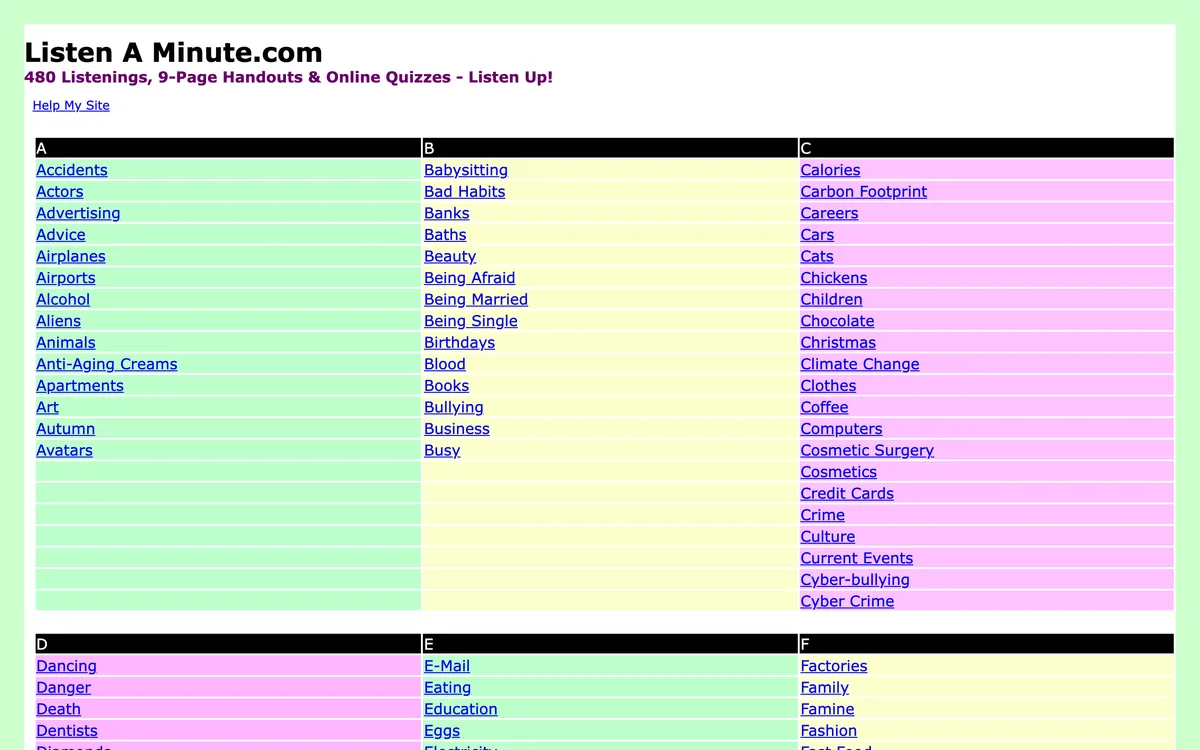
Each lesson is exactly one minute long, with a full transcript, sorted into hundreds of topics. This is the name that shows up in nearly every Vietnamese list, and for good reason: the pieces are short enough that you have no excuse to skip them.
Suits: beginners, busy people, anyone who needs a habit small enough that it can't slip.
Weak point: the reading pace is quite slow and clear compared to real life, so don't linger here too long.
2. Breaking News English
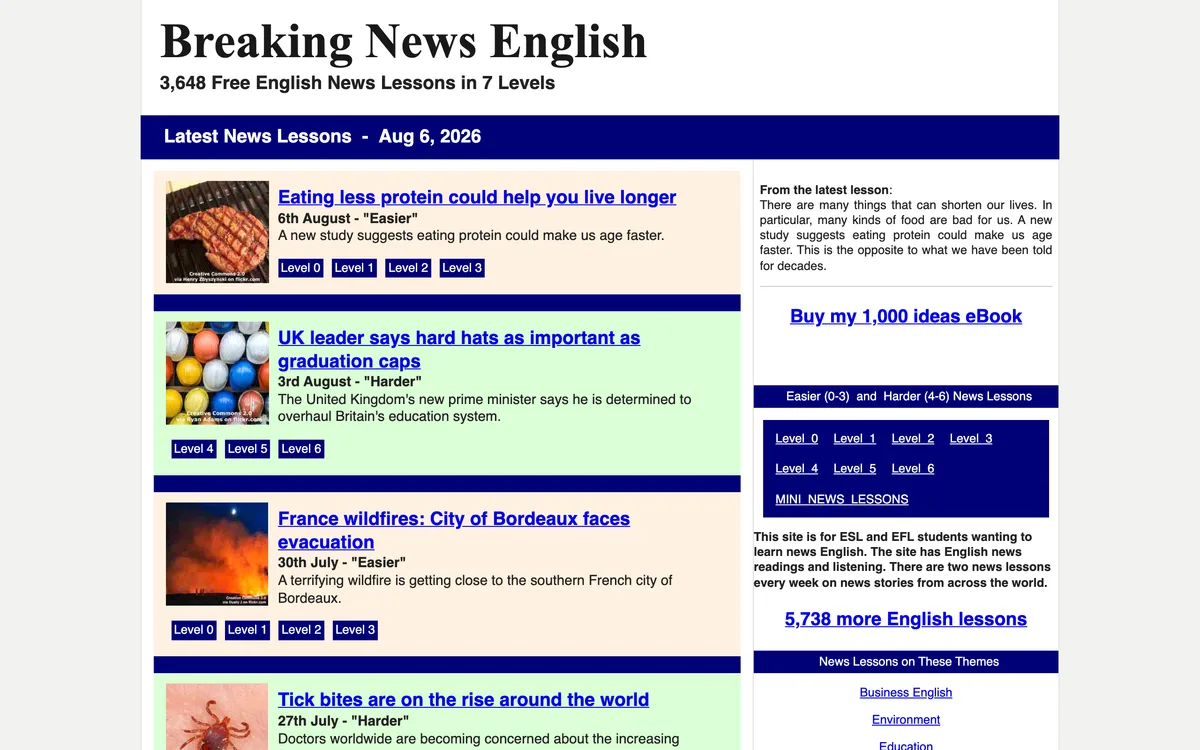
News-based lessons, each story available at several difficulty levels for the same content, plus a set of accompanying exercises. Having the same news story rewritten at multiple levels is rare and genuinely useful: you dictate the easy version first, then dictate the same story again at a harder level.
Suits: people who want current-events content and want to raise the difficulty gradually on the same topic.
Weak point: the interface is dated, and you have to organize your own study.
3. Daily Dictation
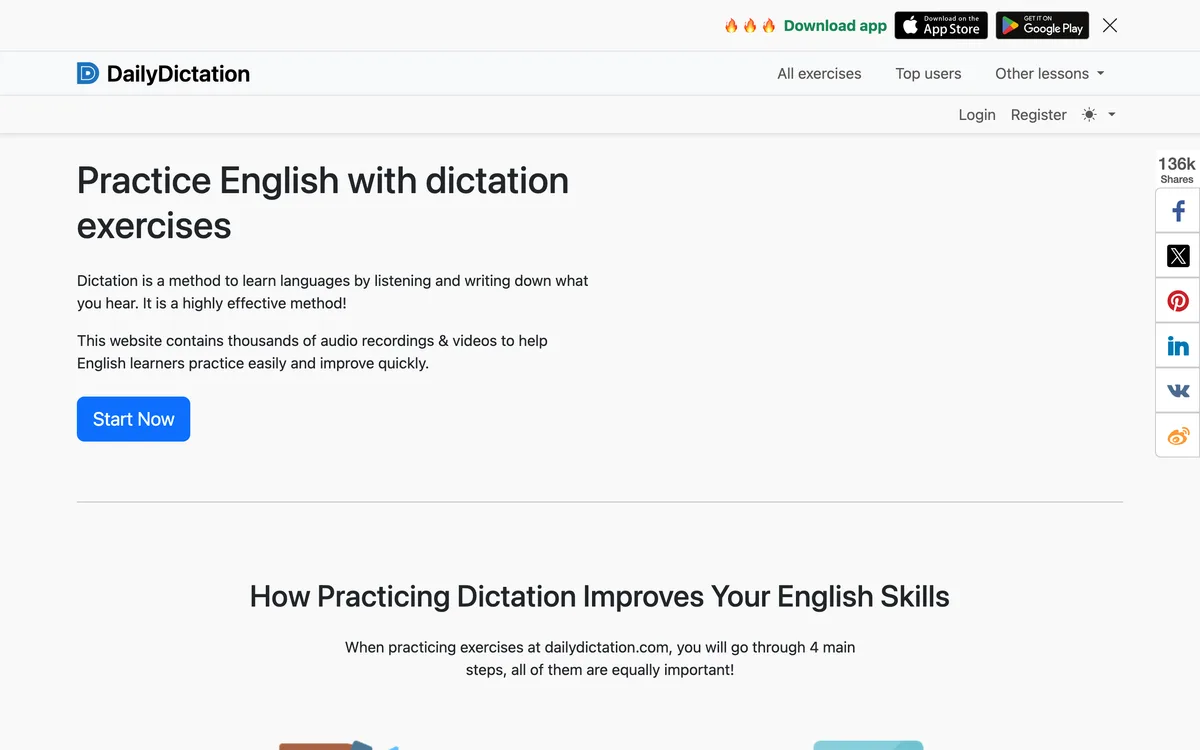
A site dedicated entirely to dictation, describing itself as exercises for every level from basic to advanced, completely free. This is one of the few tools on this list built specifically for dictation practice rather than a listening source repurposed for it.
Suits: people who want to do exactly one thing — dictate — with no extra features needed.
Weak point: the content leans toward lesson material rather than real content you'd want to listen to for its own sake.
4. Elllo
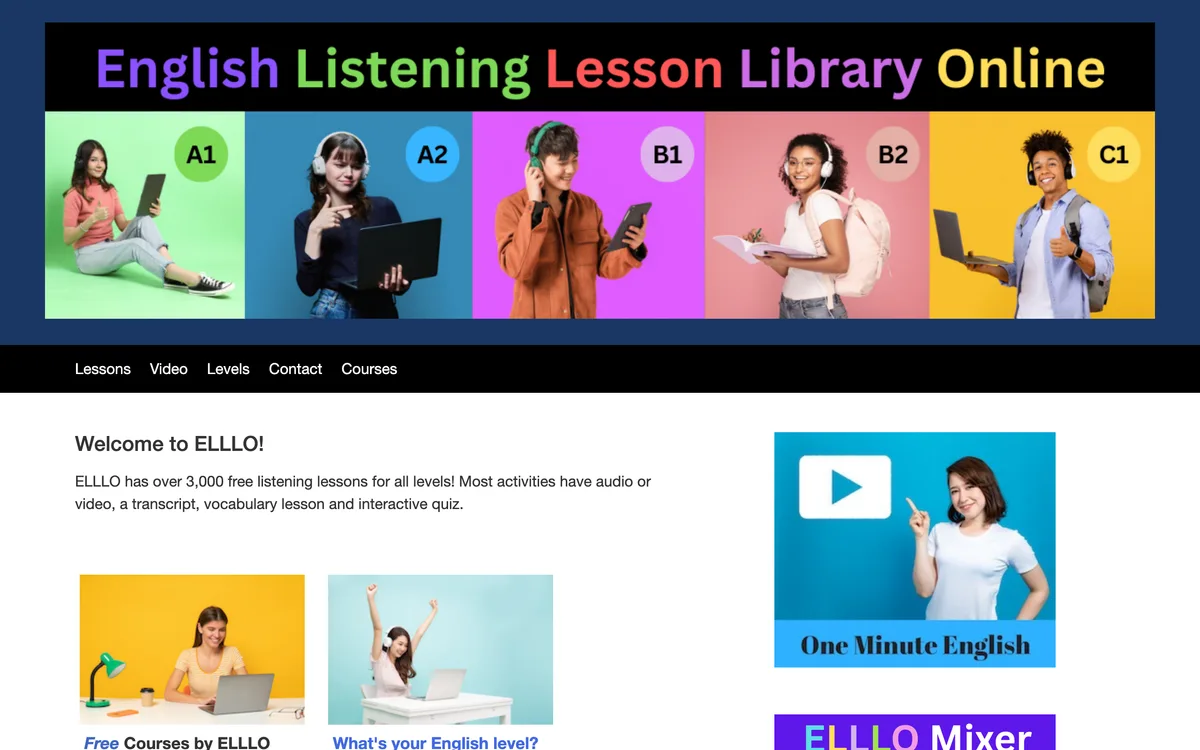
A large library of conversations with a wide range of accents, all with transcripts. Elllo's distinct value is accent diversity: you hear English spoken by British, American, Australian, Indian, Japanese speakers, instead of just one standard studio accent.
Suits: people already used to an American accent who freeze up when they meet a different one.
Weak point: the interface is scattered, hard to know where to start.
5. DOL Tự học
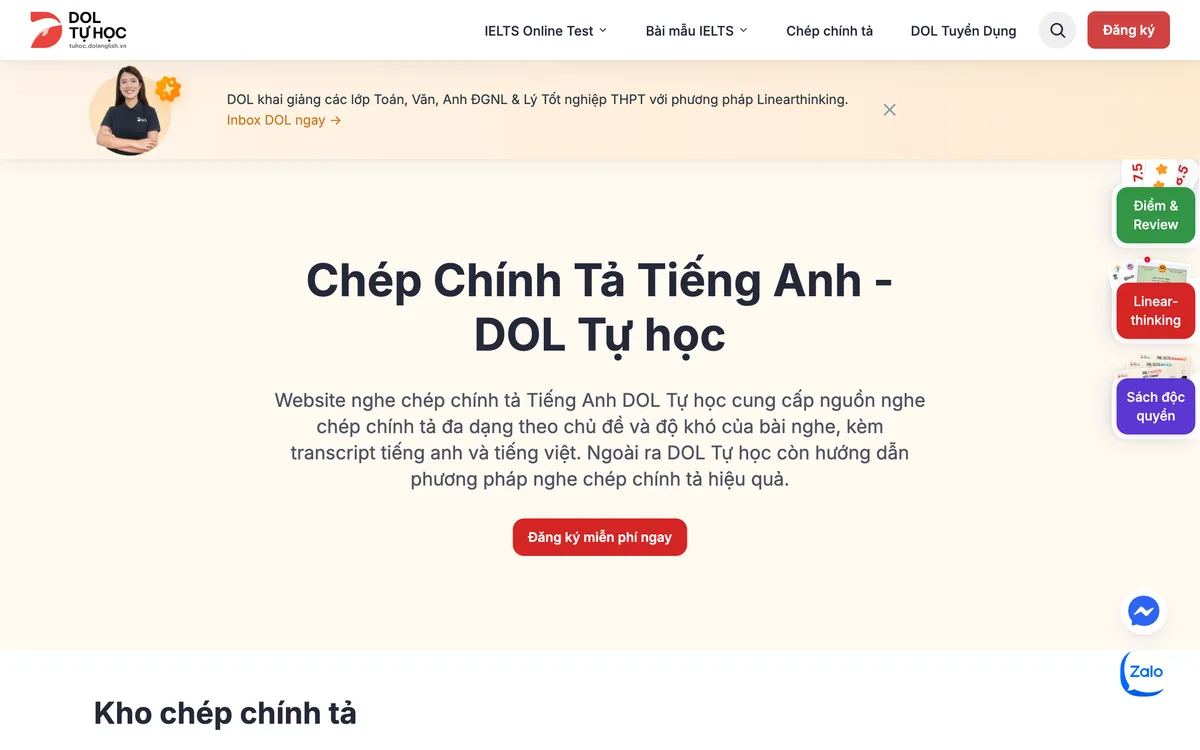
DOL's dictation tool, offering listening material sorted by topic and difficulty, with transcripts in both English and Vietnamese. Having a bilingual transcript is the clearest difference from the foreign sites, and it genuinely helps when your vocabulary isn't yet enough to understand the original.
Suits: Vietnamese beginners who need a Vietnamese-language crutch.
Weak point: having the Vietnamese transcript right there also makes it easy to end up reading instead of listening.
6. Parroto
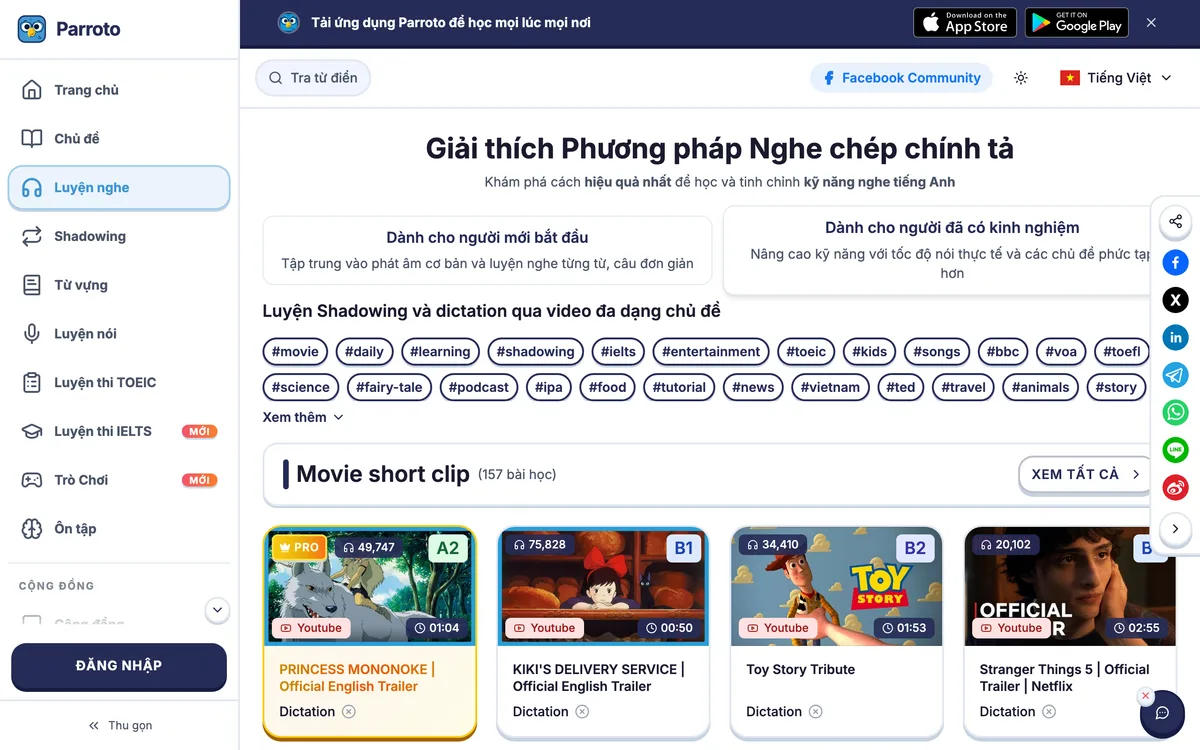
A platform combining dictation with shadowing on real videos, plus contextual vocabulary and IELTS/TOEIC prep. If you want to train both listening and speaking in the same place, this is a direction worth looking at.
Suits: people who want to fold listening and speaking into one tool.
Weak point: having many features at once makes it easy to jump around instead of finishing one thing.
7. AnhLe Online
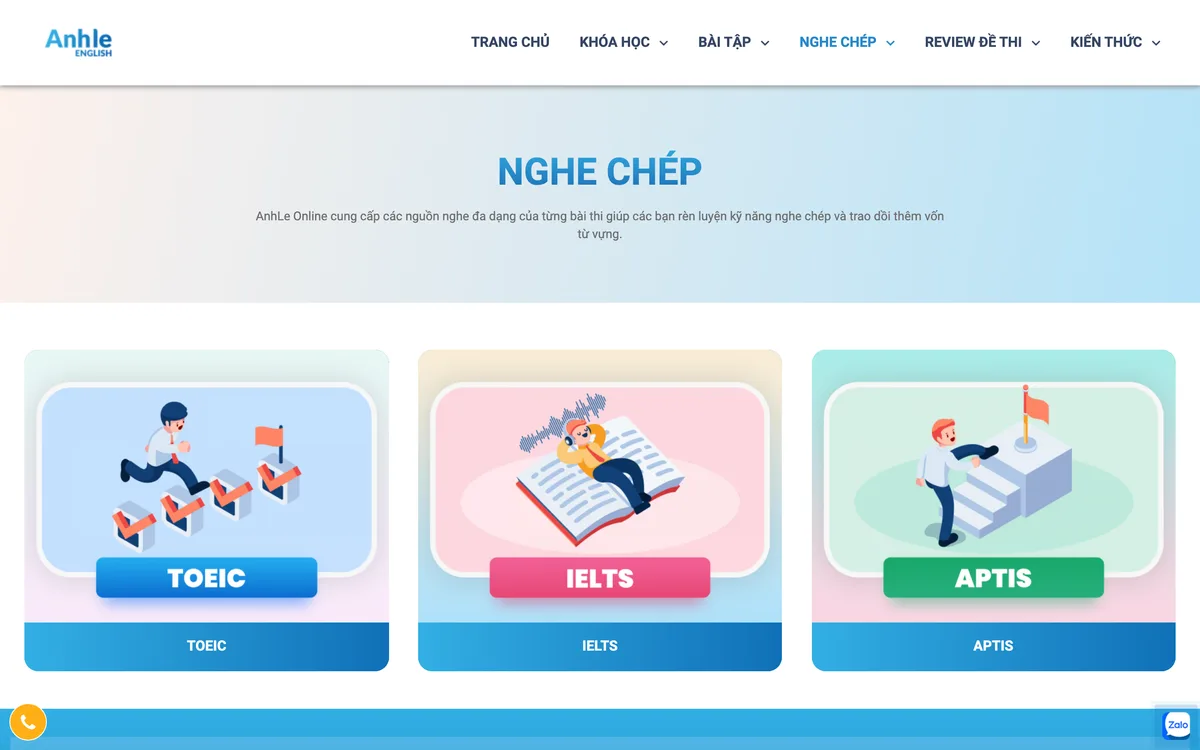
A dictation source built around TOEIC, IELTS, and APTIS test material, free of charge. If you have a specific exam coming up and want to practice with exactly the kind of audio you'll meet in the test room, this is a straight-to-the-point choice.
Suits: people currently preparing for an exam who need the exact test format.
Weak point: practicing for a long stretch on exam material gets boring, and real-life English is spoken faster than exam audio.
8. WELE
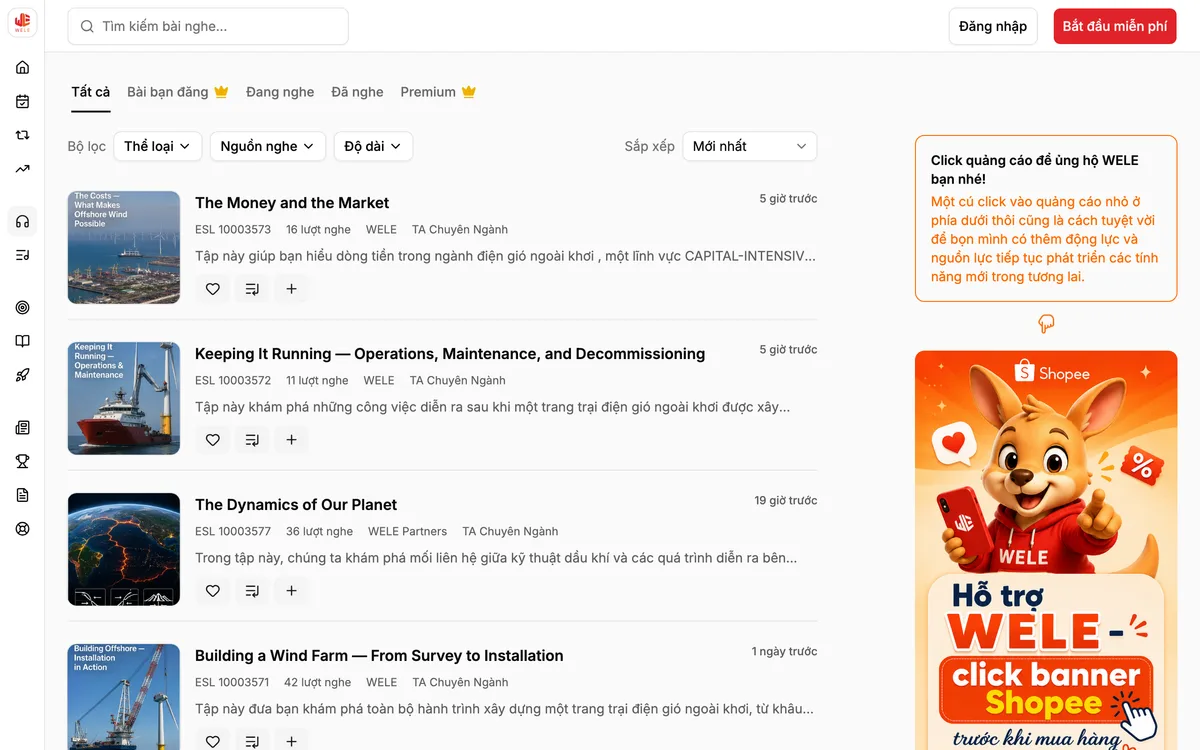
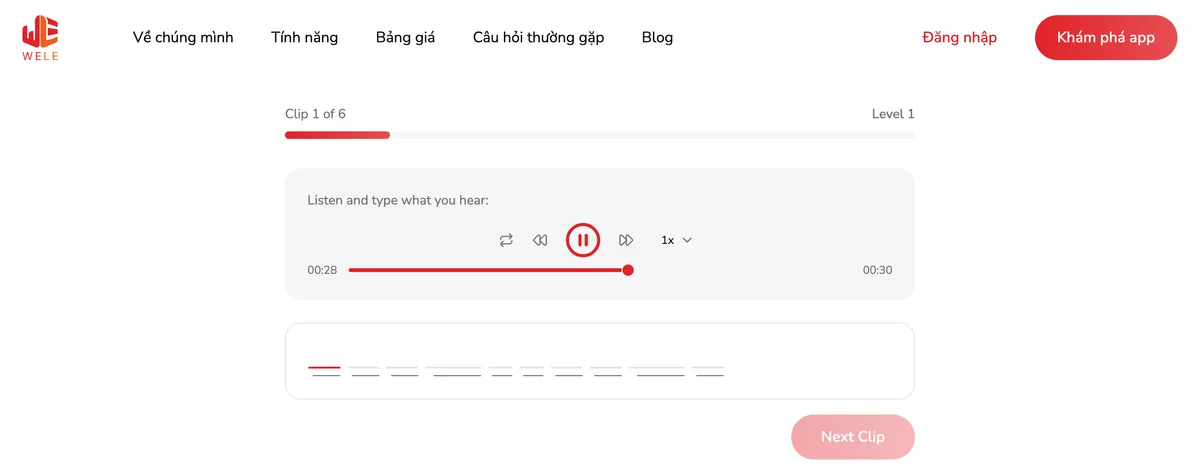
This is our own tool, so read this section with the appropriate skepticism. WELE is built around exactly the four criteria from the start of this article: real podcasts with human-checked transcripts, a player pre-cut by sentence so replaying one sentence takes a single action, a grading feature that checks word by word and highlights exactly what you missed, a library sorted by difficulty.
The biggest difference is the content: the audio is podcasts about science, history, technology, life, things you might want to listen to for their own sake, not just because you're studying English. The dictation practice feature is free.
Good for: people past the absolute-beginner stage who want real content and want to know exactly where they're going wrong.
Weak point: if you can't yet catch a slow, clear English sentence, real podcasts will be too much, start at Listen A Minute and come back later.
Quick comparison table
| Tool | Content type | Auto-grading | Best fit for |
|---|---|---|---|
| Listen A Minute | 1-minute readings | No | Beginners, busy people |
| Breaking News English | News, multiple levels | Comes with exercises | Gradually increasing difficulty |
| Daily Dictation | Dictation exercises | Yes | Just want to do dictation |
| Elllo | Conversations, many accents | No | Getting used to unfamiliar accents |
| DOL Tự học | By topic, bilingual | Yes | Vietnamese beginners |
| Parroto | Video, with shadowing | Yes | Combining listening and speaking |
| AnhLe Online | Exam-format material | No | Exam prep |
| WELE | Real podcasts, with transcript | Yes, word by word | Real content, knowing exactly where you erred |
The "auto-grading" column is the thing most worth paying attention to when you choose. Without it you can still do dictation, but you have to be your own examiner, and a tired person doesn't grade carefully.
Choose based on your level
If you still struggle with a slow, clear English sentence: start at Listen A Minute or DOL Tự học. Short passages, clear voices, and Vietnamese support when you need it. The only goal at this stage is to get used to sitting down and doing dictation every day.
If you catch the general idea but miss all the details: this is the point to switch to real content. Breaking News English or WELE. You're not short on vocabulary, you're short on the ability to catch words that get slurred over, and only content spoken at natural speed can train that.
If you have an exam coming up in the next few months: use AnhLe Online for the right format, but don't use it alone. Mix in real content too, because exam audio is spoken slower and more clearly than real life, and getting your ear used to something harder will make the exam room feel easy.
Not sure where you stand? Take the listening level test once and choose based on the result, it saves you a few weeks of guessing.
Four mistakes that make you quit
Replaying the same spot over and over until you get it. After about five tries, if it's still not coming, it's usually because you don't have that word in your head yet, listening more won't produce it out of nowhere. Leave it blank, move on, check the answer, then listen again. That's when you'll hear it.
Picking passages by preference instead of by level. Very understandable, but a twenty-minute science podcast episode isn't the place to start. Save it as a reward for a few weeks from now.
Stopping once you've finished writing. The step where you check your answers and re-listen to exactly where you got it wrong is the step where you actually learn something. Skip it and that session was just typing.
Constantly jumping between tools. Trying three sites in one week and concluding none of them fit is the surest way to make no progress. Pick one, use it for a full two weeks, then evaluate.
Frequently asked questions
How much dictation practice a day is enough?
One short passage a day, done consistently, is far better than a few hours on the weekend. Because you have to write down every sentence, this kind of practice is quite mentally taxing, keeping it short and regular will keep the habit going longer.
Do you have to pay?
No. All eight options in this article have a free tier, and for beginners the free tier is more than enough for many months.
Does dictation practice help with IELTS or TOEIC?
Yes, indirectly. The exam tests your ability to catch details while listening, and dictation trains exactly that: numbers, proper names, verb endings, function words that get slurred over. Those are also the spots where points are most often lost.
Should you write by hand or type?
Typing is faster so you get through more material in the same amount of time, and the tool can grade it right away. Writing by hand is slower, but some people find it sticks better in memory. There's no single right answer, pick whichever you'll actually keep up.
How long before you notice a difference?
Progress in listening skill comes in steps, not a straight line. You might see nothing for several weeks in a row, then suddenly a passage that used to be hard feels easy. A more reliable sign than how it feels is the number of blanks you need to leave, getting smaller over time at the same difficulty level.
Wrapping up
There's no single best tool for everyone. There's the tool that's right for the level you're at now, and what's right will change again in a few months. The one thing that doesn't change is the four criteria from the start of this article: a transcript you can trust, easy replay, grading that points out every word, content sorted by difficulty.
If you want to try dictation on real podcasts with word-by-word grading, you can start on WELE for free. And if you're a total beginner, open Listen A Minute and do a one-minute passage today. Either one is fine, as long as you do one passage today.
Read more: a 20-minute daily listening practice framework and how to pick a dictation tool so you don't give up.
